15% of the ocean is experiencing record temperatures: Double the 2023 record of 7.3%.
Average global sea surface temperature has hit a daily record high for 100 straight days.
August 2026 was the hottest & most humid globally
Ireland: Summer 2026 was the hottest summer since records began
Water temperatures in the Persian Gulf have reached 97°F.
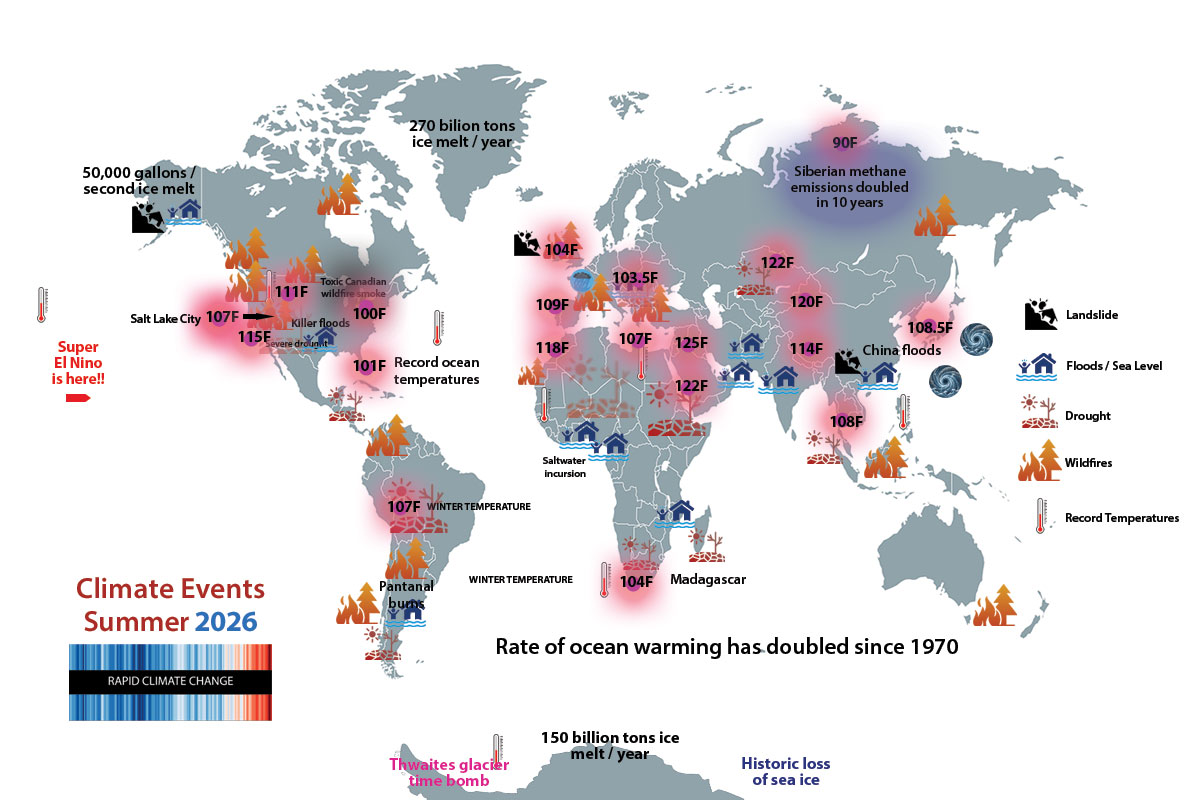
Another record breaking heat dome out West brings temps as high as 111°F (44°C) Climate models now unanimously expect the strongest El Niño on record this year. Water temperatures in the Persian Gulf, the hottest sea on the planet, have reached as high as 97°F (36°C). Since 2015, Earth’s temperature has risen at an estimated pace of 0.63 degrees Fahrenheit per decade, as opposed to just under 0.36 degrees F per decade from 1970 to 2015.
Torrential Rains and Fierce Winds Batter Naples Siberia’s methane emissions double in a decade. Extreme heat in the Swiss Alps is causing new record-breaking snowmelt in the Swiss Alps. As of July 13th, the global ocean sea-surface temperature has set a daily record for the 42nd day in a row. Landslide buries residents in southwest China’s Chongqing city | Northeastern Brazil is looking at 102°F; Spain reports 102°F and 104°F in France ; French exceptionally intense drought threatens ag. Three rugby players in Malaysia died of heat stroke; Egg-sized hailstones wrecked vehicles and caused serious injury in China; Four inches of rain in an hour submerged large parts of Comilla City in Bangladesh.
Toxic algae fouling coasts globally.
Key European rivers hit record lows
Germany heatwave continues: 100°F
Woodland Hills, CA: 111°F
One dead and 15 firefighters injured in explosive Croatian wildfires

Watch Thunder Key, an original music video
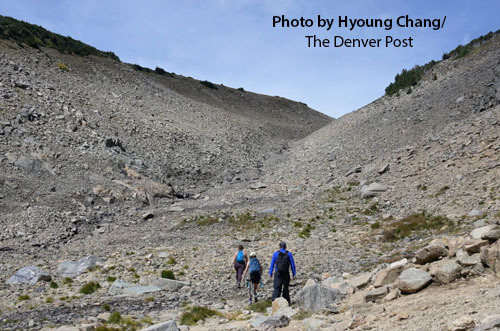
Say goodbye to another iconic glacier
St. Mary’s Glacier in Colorado has melted completely for the first time in recorded history in September 2026. This perennial snowfield is located at an altitude of 10,000 ft and had endured year-round until this summer’s record heat and low snowpack killed it. Although technically a “perennial snowfield” rather than a flowing glacier, its disappearance is a visible impact of climate change on Colorado’s high-country.
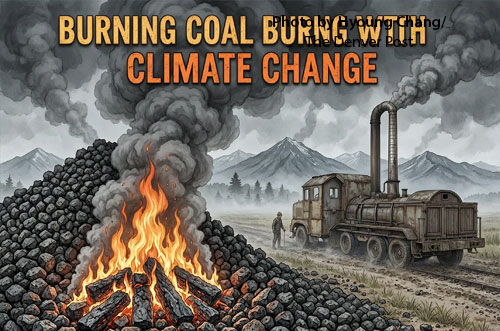
ExxonMobil is warning about the dangers of coal? WTF
ExxonMobil says the world is on course for rapid global temperature increases as coal use persists, pushing emissions beyond (imaginary) mid-century climate goal. The world is “nowhere close” to achieving the (imaginary) 2.0°C target laid out by the United Nation’s Intergovernmental Panel on Climate Change (IPCC) to avoid the worst effects of climate change. Aside from “thanks Mr. Obvious,” why the sudden interest from the oily boys who have known the global warming facts better than anyone for 50 years, but chose to keep drilling? Here’s the article.
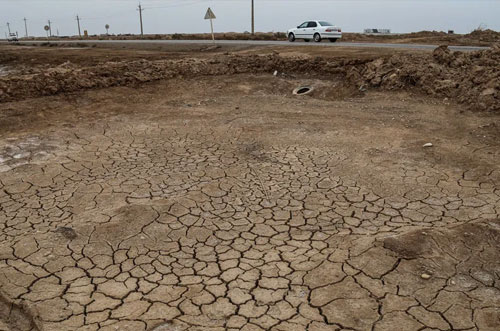
Eco-cide in Iran’s Hoor al-Azim and Zagros regions
“Wetlands like Hoor al-Azim are being deliberately drained to facilitate cheap oil extraction, the forests of the Zagros and the north are being reduced to ash under the weight of land-grabbing and villa construction, and the plunder of underground aquifers is causing the land beneath our feet to collapse and subside.” Article by Maryam Dehkordi

French wine season wrecked by climate change
France is expected to see one of its worst wine harvests of all time after extreme heat and drought damaged vineyards across the country. Industry officials expect the worst harvest for some 70 years. France, the world’s second-largest wine producer after Italy, is expected to produce fewer than 34 million hectolitres in 2026..
According to the International Organization of Vine and Wine (OIV) the 2025 figure was already a historic low, marking the lowest French output since 1957.
It has long been my contention that humans will begin to grasp the seriousness of the global warming emergency when they can’t get their stuff. Especially luxuries.
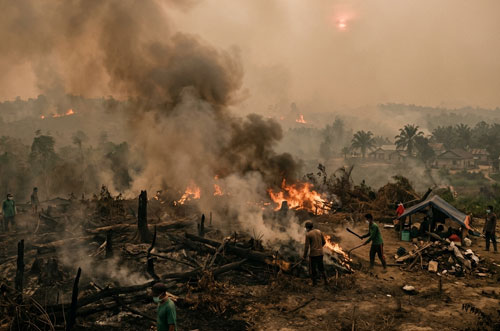
No escape from Borneo’s toxic smoke in Southeast Asia
Borneo is once again belching out dangerous wildflre emissions, as fires in the peatlands and forests of Kalimantan send a grey brown cloud of pollutants across Malaysia’s Sarawak and on to the wider region. This year is an echo of the trans border incidents of 2015, but not much has really been done. Palm oil, pulp and paper conglomerates whose business models depend on cheap land clearance have every incentive to keep enforcement weak. Singapore, where the smoke becomes unbearable, is also the home of many companies that invest in Kalimantan’s palm oil sector. The wealthy residents of Singapore don’t like imported smoke, although they obliquely finance the sources.
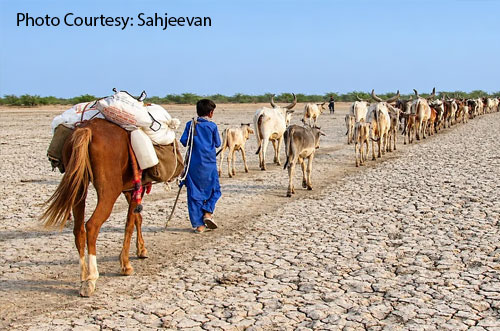
In India, drought drives another climate migration
Kutch (Kachchh), in western Gujarat, is experiencing a serious water and agricultural crisis in 2026, driven by an exceptionally deficient and delayed monsoon on top of a long-standing vulnerability to drought, groundwater depletion and salinity. As of early September, the situation is particularly severe: Kutch was roughly 60% below its normal cumulative monsoon rainfall, while Saurashtra and Kutch together were about 36% below normal. The 2026 Kutch drought is not simply a shortage of rain. It is exposing a deeper vulnerability: a naturally arid region whose agricultural, livestock and human water needs have grown while its groundwater reserves have been progressively depleted.
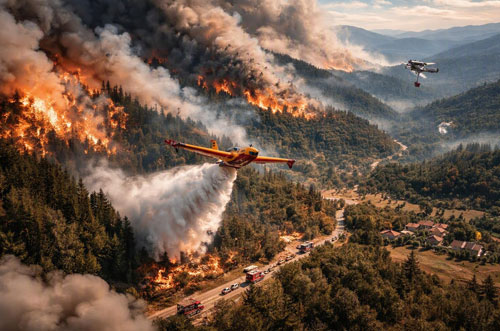
Bosnia and Herzegovina wildfires spread toxic smoke across borders
Thick smoke from major fires in Bosnia and Herzegovina was carried across a huge swathe of Dalmatia on Sunday, stretching from Split to Pelješac and even reaching some of the islands. In Split-Dalmatia County, measurements showed concentrations of airborne particles several times higher than normal. The major fire burning between Kupres, Tomislavgrad and Prozor-Rama remained out of control on Sunday morning after changing direction overnight and spreading further towards the Tomislavgrad area.
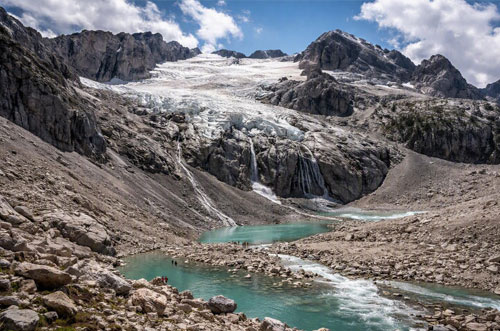
Glaciers in Italy and Slovenia nearing collapse after summer
This summer the iconic Marmolada glacier shrank by around 80 feet on average and its surface area dropped from 92 hectares to 83. The dramatic collapse surpassed a similar event in 2022, which killed 11 people.
In Slovenia, scientists are now witnessing what is likely the final retreat of the Triglav Glacier. Authorities say the last remaining patches are now disappearing, and the glacier may be gone by the end of this year.
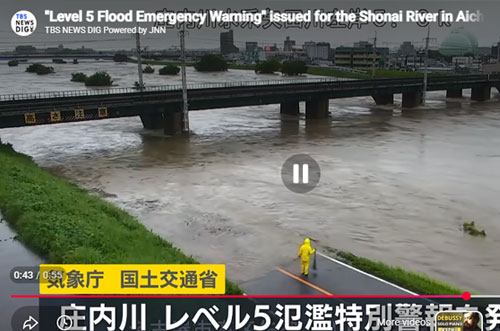
Landslide alert after another record rainfall event in Japan
One person is dead after record breaking rains hit large parts of eastern Japan from the early hours of Monday, including Tokyo, Kanagawa and Chiba prefectures, disrupting train services and forcing some school closures. 20 inches of rain came down in 24 hours in areas south of Tokyo, the largest amount there since local records began, the Japan Meteorological Agency said. Nagoya recorded 4.1 inches) of rain in one hour on setting an all-time station record as flooding disrupted roads and rail services.
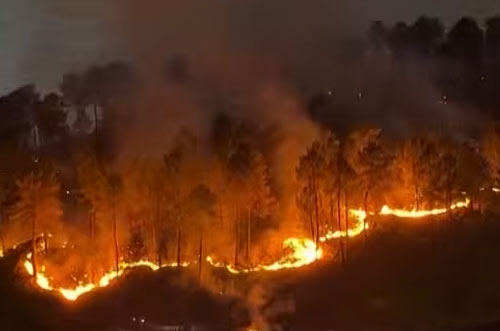
Indonesian wildfires fueled by drought and greed
Humans are getting very good at setting the planet on fire. The months long outbreak of wildfires in Indonesia are being attributed to illegal land clearing for palm oil plantations. The relentless drought gas caused them to burn out of control, with 24,000 fire fighters battling the flames since July. There was a gathering of 3,000 of the faithful to pray for rain, but it didn’t rain.
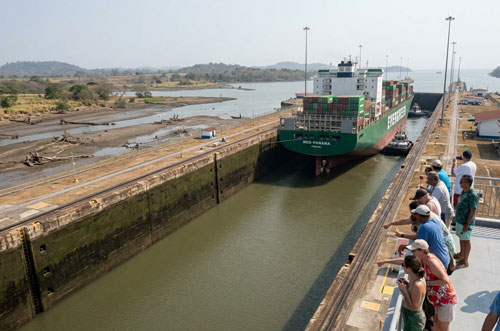
Panama Canal cuts traffic due to low water levels
The Panama Canal has reduced ship traffic because of sustained low water levels in the system. Central America is currently suffering from a severe drought that also impacts the Panama Canal. In recent weeks, the Panama Canal Authority (ACP) has reduced shipping trafficdue to lower water supply from the artificial lakes that feed the canal. The Panama Canal Authority reported a decrease of more than 10% in water levels in Alajuela from March to April. In Europe, both the Rhine and Danube are experiencing reduced shipping traffic because of low water level.
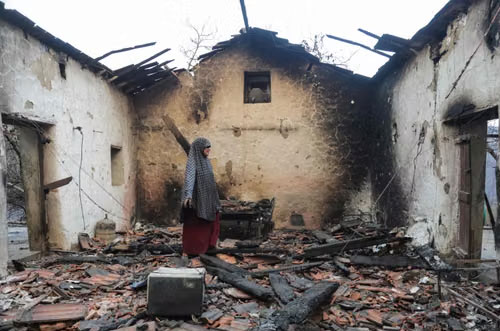
Record wildfires in Algeria kill at least 200
Between August 26 and August 30, exceptionally violent fires swept across the mountains and coastline in eastern Algeria. The country has never seen an outbreak on this scale and has been poorly prepared. Entire villages were wiped out, including El Djemaa Beni Habibi, located in the hills about 200 miles east of Algiers. While the Interior Ministry has published at death toll of only twelve, independent journalists place the number at over 200.
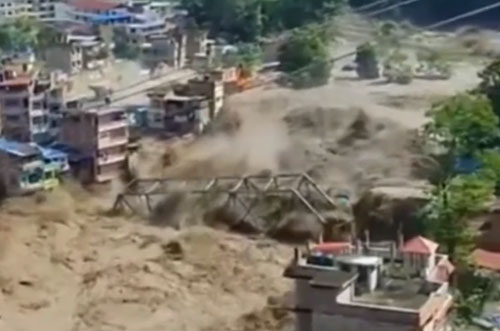
Collapsing glacier triggers fatal floods, kills thousands
Massive flash floods in a border area of Nepal and China on Wednesday killed at least 400 people and left hundreds of tourists, workers and others missing after sweeping through communities and bringing travel in some areas to a halt. Experts said an avalanche from a glacier was the likely cause in the warming Himalaya region. This increasingly common event is called a Glacier Lake Outburst.
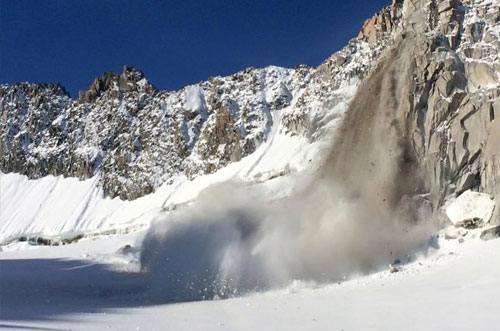
Record Alpine rockfalls as mountain “glue” melts
The exceptionally hot summer in the Alps has been marked by a record number of rockfalls, some of them fatal, with “a large majority attributable to the climate crisis.” The cause is the rapid thaw of the ice or glue embedded in the rock face of mountains, which has held the slopes secure for millennnia. This year is on pace to smash existing records both in terms of the frequency of rockfalls and the sheer volume of rock breaking away from the mountains on an almost daily basis. The total is expected to hit 450. A few decades ago, the expected number was a few dozen.
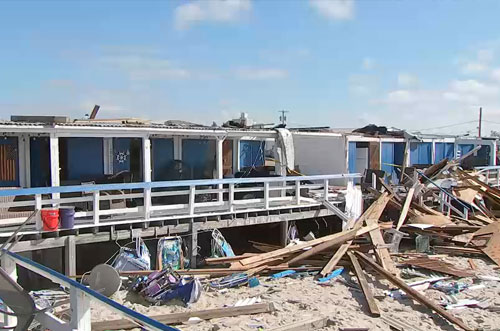
Long Island EF1 tornado rips through beach club
The National Weather Service confirmed that an EF-1 tornado touched down in Atlantic Beach as severe storms tore through Long Island in late August. The twister destroyed 50 cabanas at a beloved Nassau County beach club.
You see a lot of reporting that begins with “a rare tornado” these days, the same way you see a 500 year flood every couple of years.
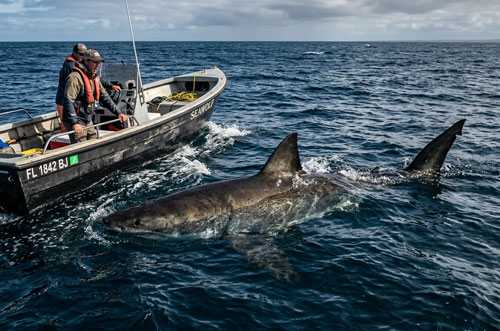
Sharks are moving into Canadian & UK as waters warm
“Good heavens, old chap… I do believe we’re going to require a considerably larger vessel.”
The Atlantic’s largest-recorded adult white shark ‘Contender’ moves into cool Atlantic waters off Canada
The shark species that used to hunt in tropical and temperate waters are moving toward the poles as oceans warm. The latest report comes from Boston, where sharks were once a rare sight indeed but are alarming citizens anew. In fact, almost every species that is able to move is heading for the temporarily cooler waters of the poles, including Jellyfish. ticks and whales.

Microbes are migrating and emerging as the planet heats
The fungal spore known as Valley Fever is expanding its range as the western USA continues to warm and dry out.
Historically, most U.S. Valley fever has occurred in Arizona and California, with cases also found in Nevada, New Mexico and parts of other western states. But as the historic drought progresses, Coccidioides spores have been documented considerably farther north, including Washington State. Climate modeling suggests that continued warming could make portions of states such as Idaho, Wyoming, Montana, Nebraska, North Dakota and South Dakota increasingly suitable for the fungus.
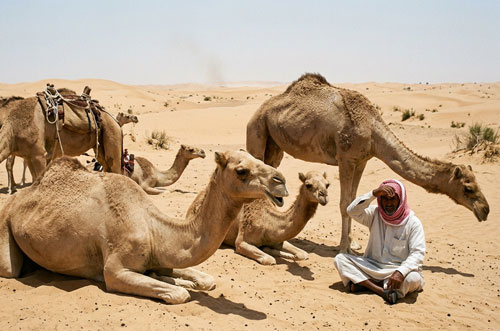
Camels are dying from extreme heat in Africa
The so called “ships of the desert” are genetically engineered to adapt to temperatures of up to 104°F. Looks like that won’t be good enough going forward, as rising temperatures in Africa are increasing mortality rates in dromedary camels. New studies are indicating that extreme heat is killing more camels in North Africa and the broader Horn of Africa region. In the Afar region of Ethiopia, herders have reported calves dying during extreme heat, with animals suffering burned feet, skin damage and severe dehydration. Reports from northern Kenya indicate a substantial recent increase in camel mortality associated with heat stress.
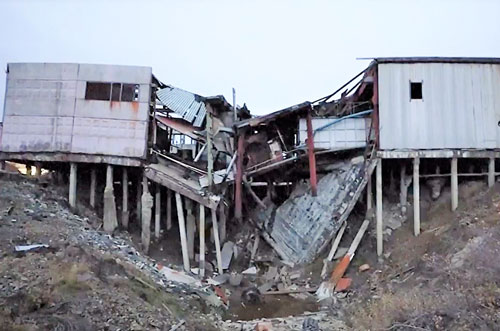
Collapsing tundra in Siberia wrecking infrastructure
It’s been going on for some time without much attention from news agencies, but another unforeseen, not obvious consequence of global warming is the sinking of the very ground beneath Siberia, northern Canada and Alaska as permafrost thaws and sinks. This has proven hard on infrastructure. A new Chinese study points out that collapsing terrain and spiking methane threaten ambitious Arctic shipping routes, pipelines and mining projects. The Arctic is warming about 4 times faster than the rest of the planet, which is pretty fast. There is also a crazy ass feedback loop that involves methane release.
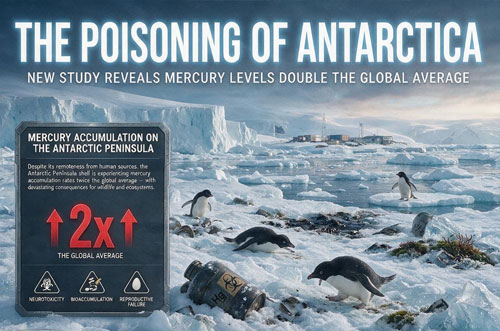
Global warming accumulates Mercury in Antarctic waters
A new study paints a grim picture of toxic heavy metal pollution in Antarctica. The research indicates that, despite its remoteness from anthropogenic emission sources, the Antarctic Peninsula shelf exhibits a mercury accumulation rate twice the global shelf average. “Since industrialization, this accumulation rate has increased by 160%, making the Antarctic Peninsula one of the major hotspots of marine mercury enrichment. This might seem to be a far away problem, but the Peninsula juts upward toward South America, and the marine and bird life their absorb the toxins.
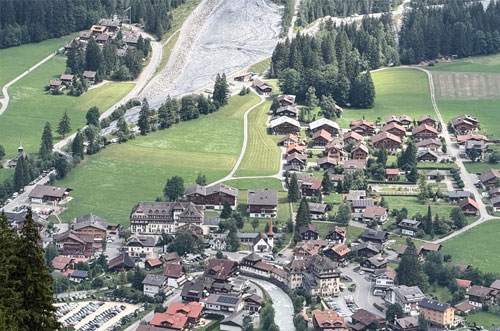
Unstable mountainside threatens yet another Swiss village
Global warming is threatening the very structure of Alpine regions as the ice that holds mountains together melts away. An unstable mountain rock formation looming above the Swiss village of Kandersteg threatens a landslide that could rival the disaster that destroyed nearby Blatten last year, a collapse scientists link to thawing permafrost and glacier dynamics. The 1,300 residents have yet to evacuate.
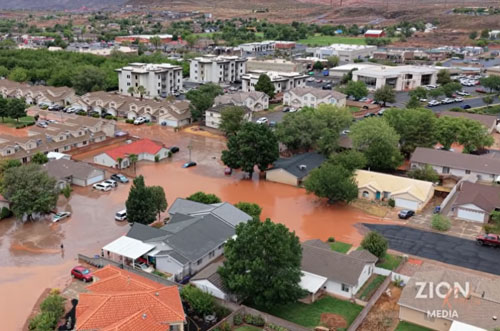
Massive flooding in Utah surprises region
The ironically named Hurricane, Utah experienced a surprise visitation by a nasty flash flood, not a common occurrence in these parts. A video shared with KUTV 2News by Zion Realty Media shows cars nearly fully submerged in muddy water.
“Flash floods don’t just happen in the canyon.”
And yet, it did happen.
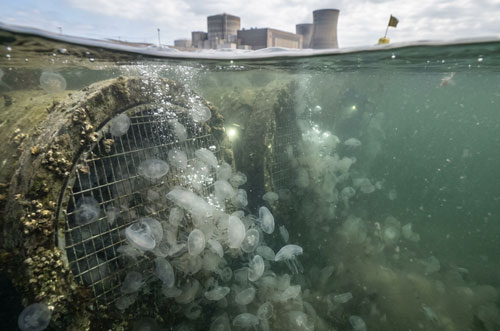
Return of the jellyfish onslaught shuts down nukes
In 2025, the Gravelines nuclear power plant in France spent hundreds of thousands of euros to stop jellyfish clogging its pumping systems. but the evil jellies were back again in August 2026 (the same date as last year!). Another shutdown as the jellies cozied up to the intake.
European nuclear reactors face another global warmng-driven challenges to their cooling systems. On the Rhine and Danube, historically low water levels have reduced cooling water available to nuclear facilities. In mid August Romania shut down the Cernavoda nuclear plant due to record-low Danube river levels. More on the jelly threat.
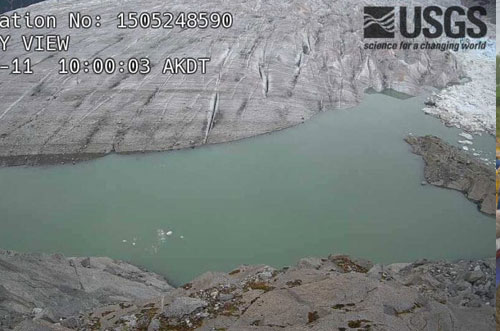
Another Glacier Lake Outburst in Juneau, Alaska
On Aug. 12-13 another flash flood from the Mendenhall Glacier reached a few homes, fewer than the events of last year. The glacial lake flood outbursts that have become an annual event near Juneau Alaska reflect another a global menace becoming more common in Alpine regions. The GLOF events are an indication of the general instability of mountain slopes and glaciers around the world. Virtually every glacier on the planet is melting, most very rapidly. More information here.
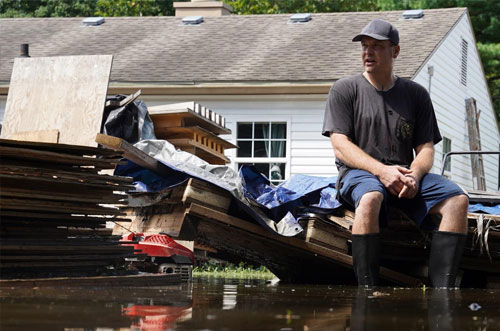
Death toll rises in killer Indiana storms
Days of storms and flooding in Indiana left at least seven people dead as floodwaters peaked in Indianapolis’ White River. A 4-year-old boy, three men and three women died since the storms began Aug. 11. Officials in Jennings County, in the southern end of the state, said the boy was killed when a tree crashed through his bedroom during strong winds.

Hunger in Mozambique following devastating floods
“We either die from the floods, or if we survive, hunger takes over.”
Mozambique is still recovering from one of its most damaging flood seasons in recent years. The disaster affected communities across several central and southern provinces, including Gaza, Maputo, Inhambane, Sofala and Zambezia. Fields disappeared under water, harvests were lost, and roads used to move food between farms and markets were damaged.
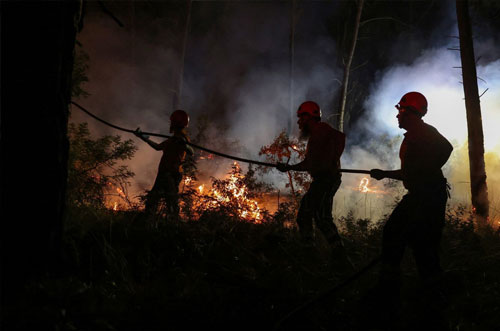
Wildfires torch France, UK, Germany, Croatia and Greece
Evacuations numbering in the thousands continue across Europe as drought spreads and heatwaves wear on relentlessly. Across the channel wildfires also rage in the UK, with the country experiencing the summer’s fifth heatwave and high temperatures on Friday after the hottest day of the year on Thursday.
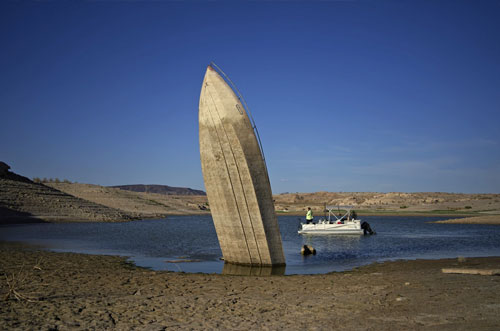
Lake Mead hits lowest level of all time
Mid August saw the long predicted Colorado River crisis move closer to reality as Lake Mead, the largest reservoir in the United States, fell to its lowest level on record. Its water level dropped even farther over the weekend, and experts say it could continue to fall through the rest of the year..
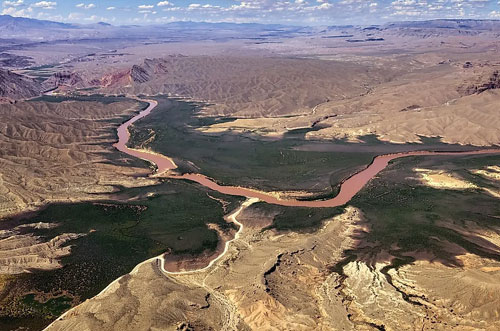
< Two largest US reservoirs near unprecedented crisis >
The crisis at Lake Mead and Lake Powell is now much more than a drought emergency. It is a structural water-supply crisis on the Colorado River, produced by a combination of chronic over-allocation, two-plus decades of drought, warming temperatures, and exceptionally poor snowpack.
Detailed, scientific report.
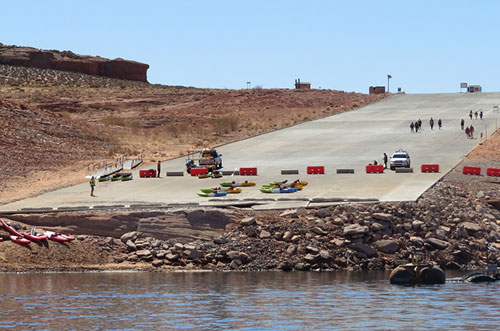
Lake Powell down to 23% capacity
Lake Powell is also approaching a critical threshold. It is only about 23% full, and its elevation has fallen toward the level at which Glen Canyon Dam loses its ability to generate electricity..
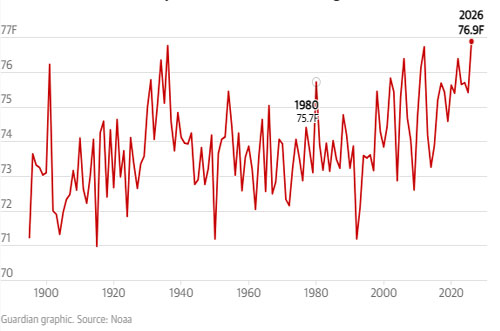
July 2026 hottest month ever in the United States
July was the hottest month ever recorded in the US, with repeated heatwaves shattering all previous monthly temperature records over 132 years of reliable measurements. Last month’s average temperature was 3.3°F (1.8°C) higher than the 20th century average for the contiguous United States according to new data from the National Oceanic and Atmospheric Administration (NOAA).
This means the month was the hottest July, and hottest of all months, surpassing previous high marks set in July 1936 (Dust Bowl) and July 2012.
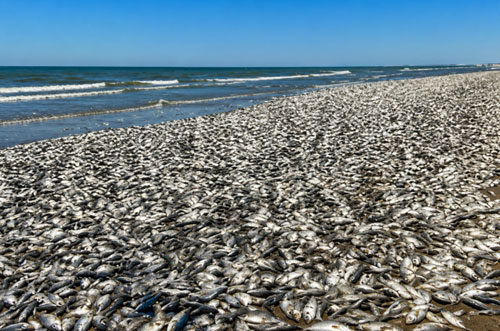
Heating ocean is causing mass marine mortality off SA
Major mortality events for sardines and other fish are occurring on the western coastline of South Africa. The die-off involves multiple species, though sardine remains the most frequently reported. Observations indicate the event spans a significant range from the coast out to 50 miles.
While the cause of thousands of dead sardines washing ashore in the Western Cape has not yet been confirmed, experts say climate change is disrupting marine food chains and fish migration patterns.
South Africa’s warming oceans are placing growing pressure on marine life while also threatening the livelihoods of fishing communities along the country’s coastline.
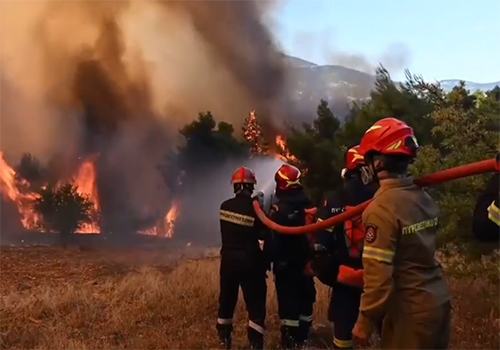
Athens region has lost almost half of its forest
Over the past ten years, about 42% of the forests that once covered the Attica region of Green have been torched by wild fires..
More than 51,200 hectares have been lost out of a total 123,000. WWF Greece said wildfires have forced more than 10,000 residents and visitors from their homes, with burned land expected to top 20,000 hectares,
Satellite images show more than 18,000 hectares scorched since late July in major fires on Crete, Paros, southern Viotia and western Attica.
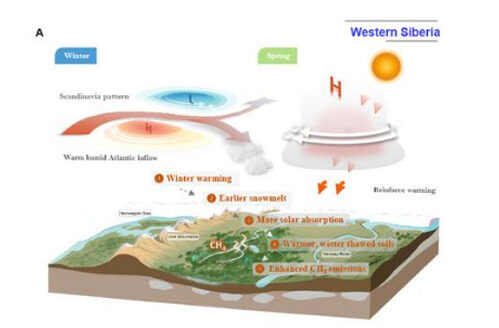
Siberia’s methane emissions double in a decade
Rapid warming combined with increasing wildfires and shifting wetland activity, is driving a sharp rise in methane emissions in the the vast permafrost regions of northern Russia. Methane is a particularly potent greenhouse gas, trapping significantly more heat than carbon dioxide over short timescales, and is a major contributor to global warming. In general, people have no idea how bad this is.
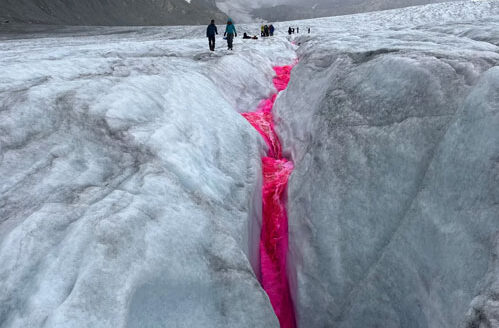
Record heat in Swiss Alps accelerating glacier collapse
Switzerland’s Rhône Glacier lost more than 12 feet of ice last month after more heatwaves swept Europe. While the wildfire onslaught captures global headlines, the less obvious collapse of Alpine glaciers goes generally unremarked. However, the growing impact of rising temperatures on Alpine glaciers has alarming short and long term effects. This critical glacier has been melting at an average rate of around 4 inches a day since mid-June. A combination of low winter snowfall and unusually high temperatures has left the ice exposed, raising concerns that 2026 could rival the 2022 loss record. The glacier is the source of the Rhône River.
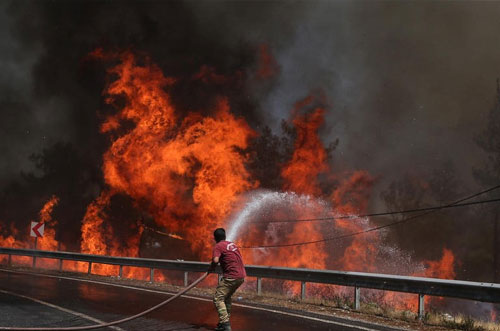
106°F in Serbia as wildfires burn unchecked
More than 1000 acres of land and forest have burned across Serbia in mid-august as flames spread to residential areas. Thick grey smoke drifted over a wooded area in north-east Serbia on Friday as authorities raced to contain a major wildfire, while multiple other blazes raged across the country amid extreme heat and prolonged drought gripping the Balkans.
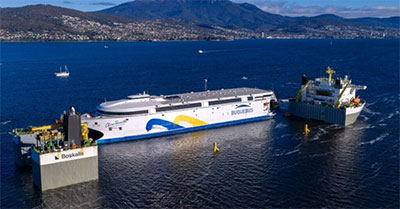
No Water in Danube to cool Nukes, Rhine at record low
Shipping on Europe’s key rivers has been severely curtailed as water levels reach new lows. Nuclear plants have been shut down in Hungary and the Viking Alur cruise ship ran aground in the Rhine.
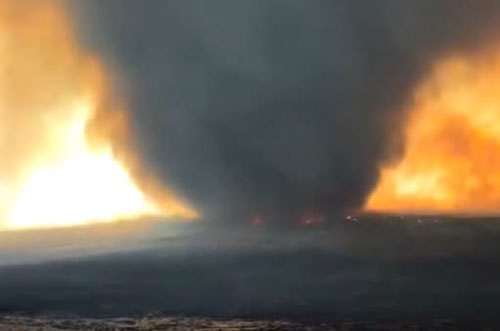
Huge Firenado in Oregon as wildfire onslaught continues
“Pretty wild to see. We’ve all seen fire whirls before, but nothing close to this size.” – Phil Sitz, USWFS
A massive “firenado” is filmed n southeast Oregon July 31, as wildfires sweeping across the pacific northwest burnt almost two million acres of land.
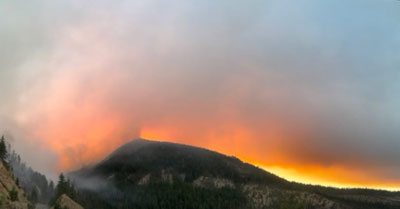
Spokane area evacuations as Oregon sets new wildfire records
Dozens of large fires in Oregon have destroyed almost 2 million acres in 2026, surpassing the previous record of 1.93 million acres in the 2024. There was an emergency evacuation of over 300,000 on Aug. 4.

Shanghai climate whiplash: heat | floods | heat
Record rains followed record heat (104°F)
as Shanghai roads flooded after thunderstorms brought torrential rain to the city on mid-July. More than 8 in. of rain of rain fell within five hours in Yangpu district, inundating underground supermarkets and malls. Local weather authorities expect heavy rain to continue in the coming days.
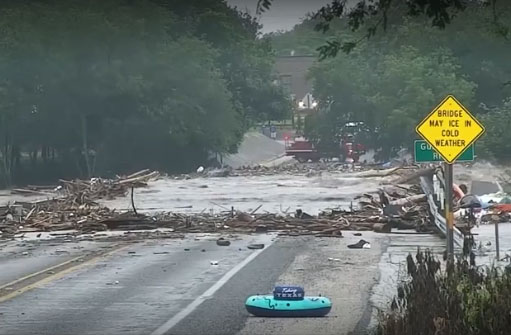
Kerr County & Central TX hammered by killer floods
Two people died in fast moving flash floods in the same area of Texas still recovering from the deaths of two dozen campers last year. The floods on the Guadalupe River forced hundreds of rescues in western Kerr County,. Rescuers saved more than 200 people, including stranded drivers and people trapped in homes.. More rain is expected.
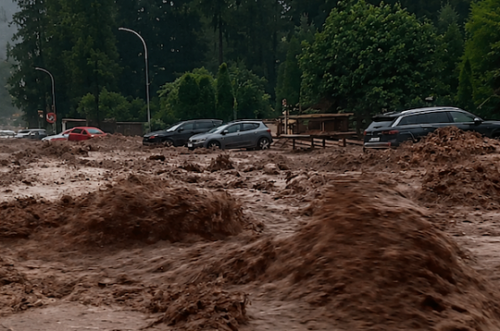
Cars swept away in Romanian mountain floods
A powerful flash flood swept through the mountain town of Bușteni July 19, carrying cars, rocks, and debris through the streets and blocking traffic on the busy DN1 national road. Emergency crews rescued several people trapped by the floodwaters, while dozens of homes were inundated.
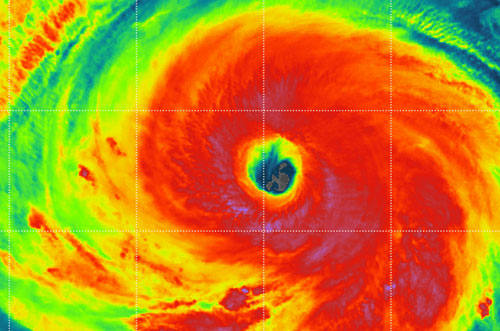
The winds
180 MPH Super Typhoon Bavi record breaking wrecking ball
The ninth typhoon of the year formed over the northwestern Pacific Ocean on July 2. It moved northwestward and intensified rapidly, reaching super typhoon status just 42 hours after forming after four consecutive upgrades in intensity. The storm was about 1,000 in radius at its peak.
Bavi reached peak intensity with maximum sustained winds of 180 on July 4 and maintained super typhoon strength for about 135 hours, a rarity. The extreme winds extended about 100 mi from the center, twice as much as expected.
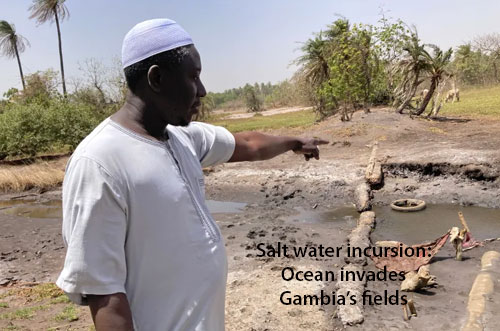
Ocean intrudes on Gambia’s fields as sea levels rise quickly
A combination of climate change and human activities is pushing ocean waters further into the coastal African nation of Gambia, threatening ecosystems, aquifers and agriculture.
“We call it a ‘wet desert.’”
The incursion is manifesting along coastlines and in river deltas, where rising sea levels move saline water into fields and villages. The ocean water makes its way underground, changing the chemistry of the soil Droughts increase salinity too, since there is less rainfall to dilute or flush the salt out. Soil and aquifer salinity levels are increasing as coastal cities pump more fresh water out of the ground, sucking ocean water in. Both phenomena are expected to worsen with global warming.
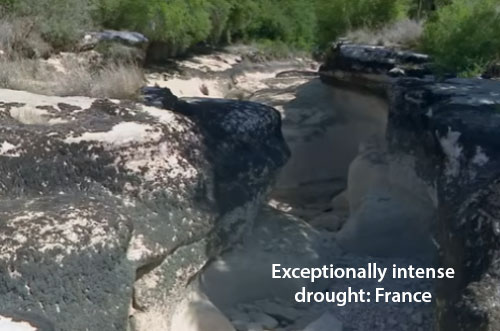
French exceptionally intense drought threatens ag
Large parts of France are facing water restrictions as the country grapples with a, intense, prolonged and early drought. France has been experiencing its third heatwave in as many months, accompanied by fierce wildfires further fueled by dry conditions. Many key rivers and streams are historically low with flow rates falling rapidly across the country since June and a quarter of small water channels running dry.
“Climate change is causing “a profound disruption to the water cycle”

Landslides kills dozens in Chongquing, China
An unknown number of people were buried after a landslide struck a county in the southwestern Chinese city of Chongqing on Friday, causing multiple residential buildings downhill to collapse, according to state media.
Aerial footage from CCTV showed rock and debris falling on a cluster of riverside residential buildings, while people could be seen fleeing with a thick plume of dust billowing behind them.
.
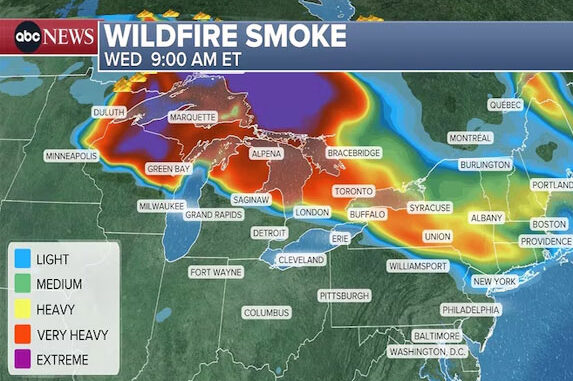
Apocalyptic skies in USA as Canada burns again
More than 830 wildfires were burning mid July in Canada, along with more than a dozen in northern Minnesota. The conflagration is growing (July 15) with no containment. , near the border, growing with little or no containment and forcing mandatory evacuations. Massive quantities of poison smoke are blowing into the Midwest and Northeast. Some of the largest wildfires are burning in heavy forests , spewing even more smoke than previous fires. It escapes many that smoke from these fires is very toxic, with effects that many manifest many years later.
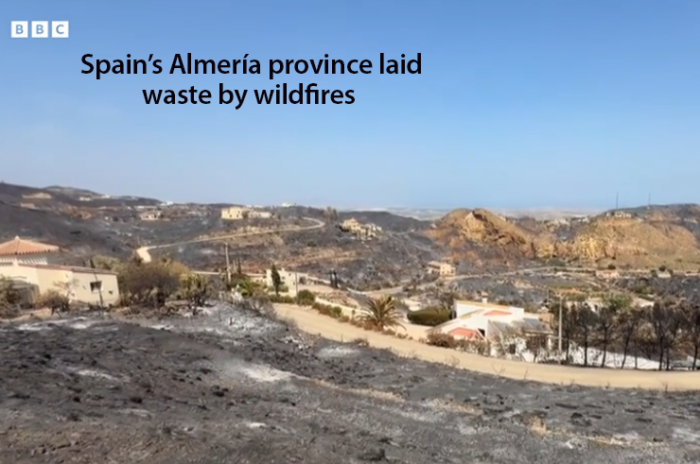
12 dead in horrendous Spanish wildfires
Described by a BBS reporters as “a sea of black,” the village of Bédar, in southern Spain’s Almería province has been virtually razed to the ground by a massive wildfire The blaze spread rapidly through the region in early July. Hundreds of firefighters have fought the fires, which have claimed the lives of 12 people. Wildfires have burned through 16,300 acres) in the province. France, Portugal and Spain. have seen devastation early this summer by a sustained heatwave with temperatures of around 104°F (40C) .
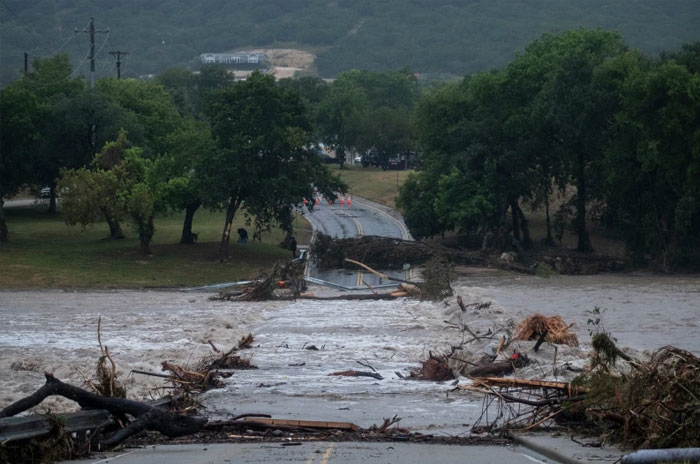
Central Texas hammered by another killer flood
Two people have died in fast moving flash floods in the same area of Texas still recovering from the deaths of two dozen campers last year. The floods have killed two people and forced hundreds of rescues in Uvalde, Edwards and western Kerr County, much of which is awaiting help from the Feds and Texas. Rescuers saved more than 200 people, including stranded drivers and people trapped in homes.. The hardest-hit areas are expecting more rain and are not out of danger yet. More
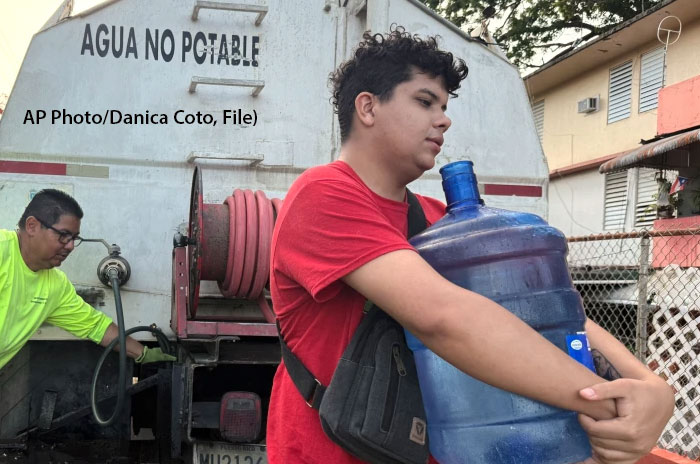
Puerto Rico drought continues as water rationing begins
Puerto Rico announced water rationing measures on Thursday as a drought grips the U.S. territory, worsening chronic water shortages that have forced the governor to declare a state of emergency. Thousands of people in the island’s northeast region now face 48-hour rationing periods. The rationing program will affect several communities in the cities of Canovanas and Rio Grande as temperatures continue to rise.
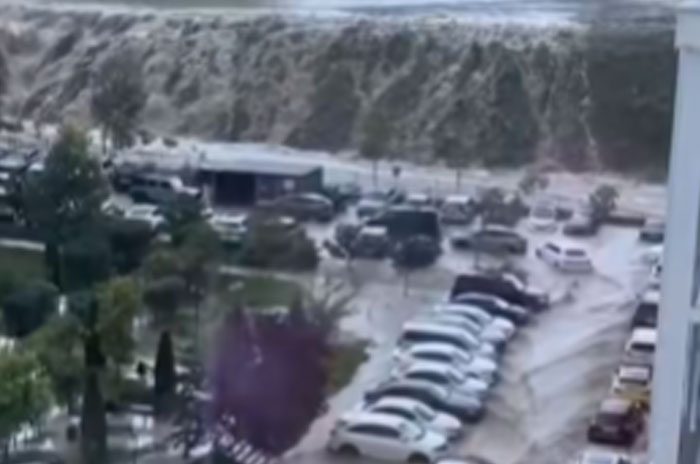
Russia’s Sochi region again surprised by landslides
On July 15, heavy rains caused flooding in the southern Russian resort city of Sochi disrupting traffic and damaging vehicles. Residents of the Ministerskie Ozera apartment complex woke up to a nightmare after torrential overnight rain triggered severe flash flooding. Streets were covered with mud and debris after torrential rain and thunderstorms caused the Bzugu River to overflow its banks.
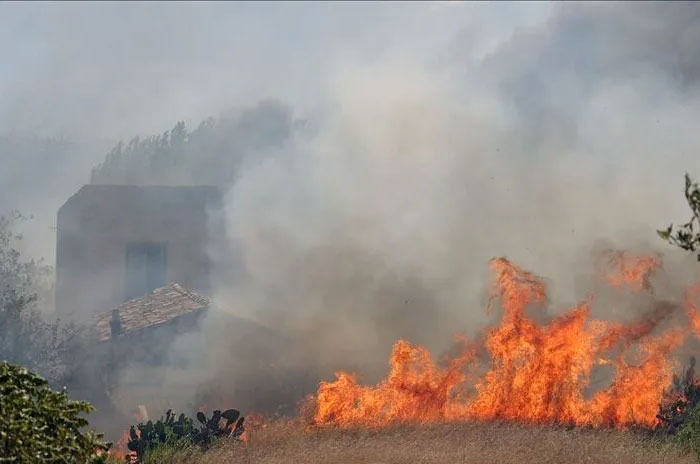
Fire and Rain: Sicily’s climate whiplash
Sicily goes from fire to hail in a matter of hours. After days of African heat, scorching temperatures, and muggy weather, the island is dealing with wildfires in several areas and the first violent thunderstorms heralding the change in weather.
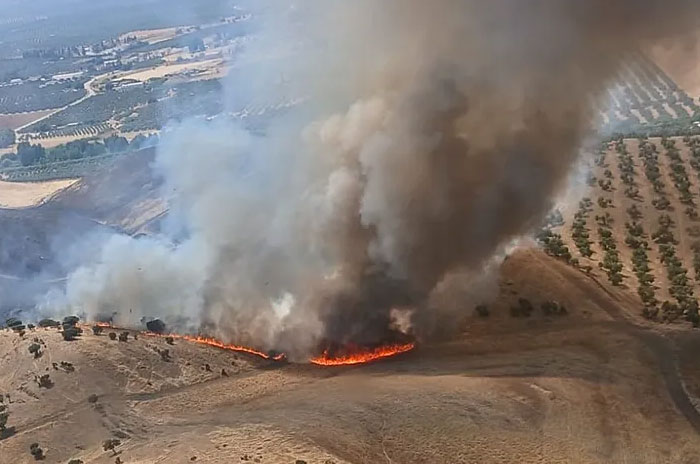
200 evacuated in Andalusia: 113°F record
Spain has just emerged from a record-breaking heatwave that left hundreds dead and pushed temperatures beyond 113°F. Following a record dry spell in May, topsoil has been stripped of moisture, eliminating the land’s natural ability to cool itself – and creating near-ideal conditions for fires to ignite and spread. Authorities have warned of a high risk of wildfires amid a worsening drought, with the accumulated heat expected to persist into early July.
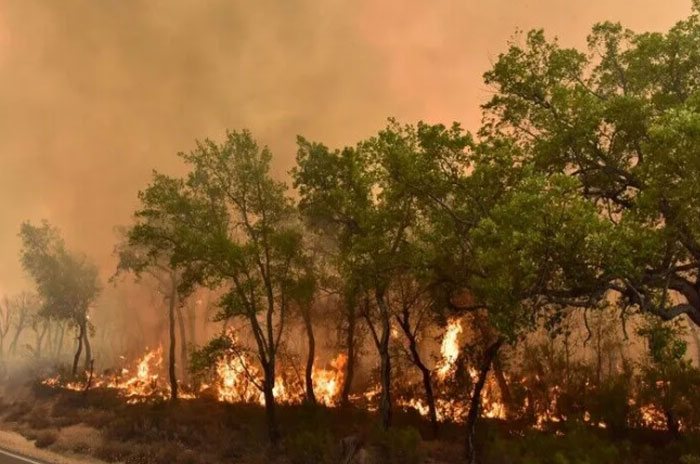
Morocco issues red alert as temps hit 116°F
The fire risk warning comes alongside a weather alert issued by the General Directorate of Meteorology regarding a heat wave from Tuesday through Thursday, with temperatures reaching up to 46 °C (116 °F) in some regions of the country
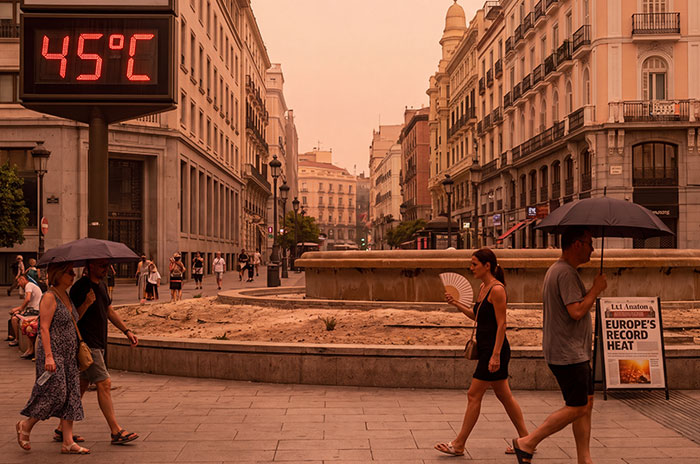
Killer European heat dome to return in July
Parts of central, eastern and southern Europe are sweltering this week with Budapest forecast to exceed 104°F today. Temperatures are forecast to soar across much of western Europe early next week, after a record-breaking heatwave caused hundreds of deaths. The late June 2026 heat dome produced record temperatures in Paris, with four nuclear reactors shut down because the cores could not be cooled.
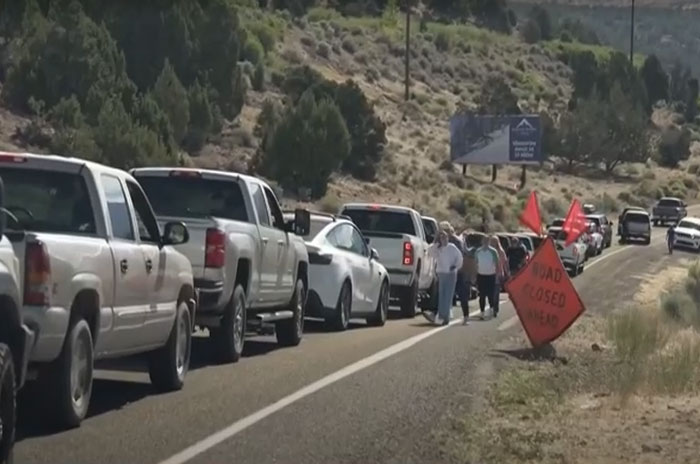
Dangerous heat wave grips USA as wildfires trigger evacuations
Evacuations have been initiated in several states due to wildfires as a prolonged, dangerous heat wave intensifies across the eastern half of United States the week of June 30. As part of the wave, some all-time high temperature records could be set later this week, NOAA’s Weather Prediction Center said. In all, some 90 million Americans live where an extreme heat watch or extreme heat warning is in effect.
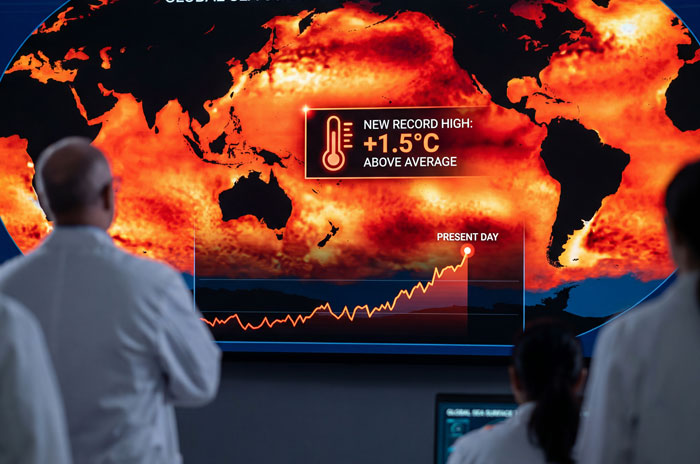
Global ocean sets new all time heat record in June 2026
European Union monitors say the first half of 2026 was marked by sustained and exceptional ocean warmth and forecast more to come.
“Current conditions could indicate the beginning of a new phase, leading, once more, to uncharted territory.”
Warmer oceans increase moisture in the atmosphere, providing fuel for tropical cyclones and destructive rainfall.

Ho Chi Min City submerged after brutal heatwave
Heavy rain swept across Ho Chi Minh City on June 15, submerging roads in Thao Dien, the city’s largest expat neighborhood. The storms and floods follow on an extended period of high temperatures.
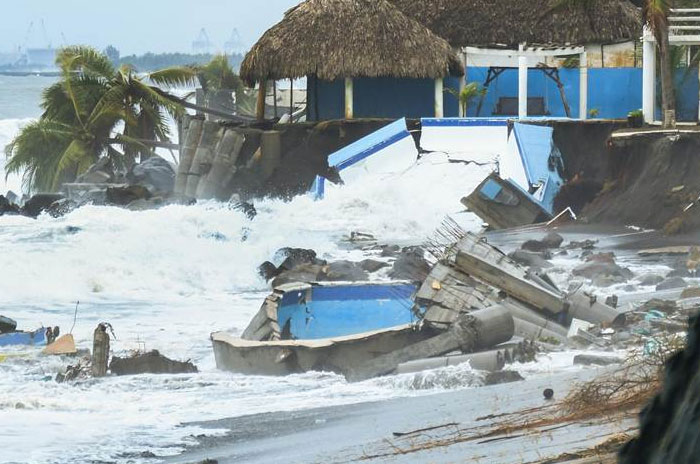
Cristina smashes Guatemala as global warming takes its toll
Tropical Storm Cristina is the latest in a series of global warming driven event that are pounding away at the viability of Guatemala’s Pacific coast. Rapidly rising seas, violent surf and increasingly powerful storms are clawing away coastal towns and neighborhoods, threatening economically critical tourism as infrastructure collapses.
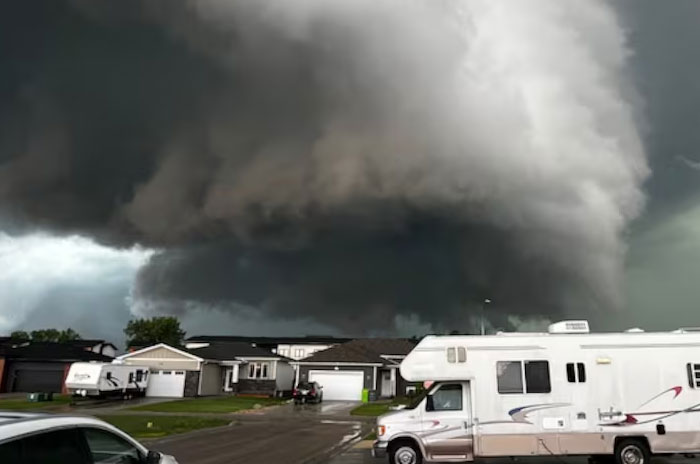
Once in 200 year floods, tornadoes in Manitoba
A “once in two hundred years” flood hit western and southern Manitoba in mid-June, threatening the planting season and submerging a number of communities. More than 10 inches or rain and several tornadoes were sighted. Evacuations, power outages and washed out roads have been reported by authorities in the region.
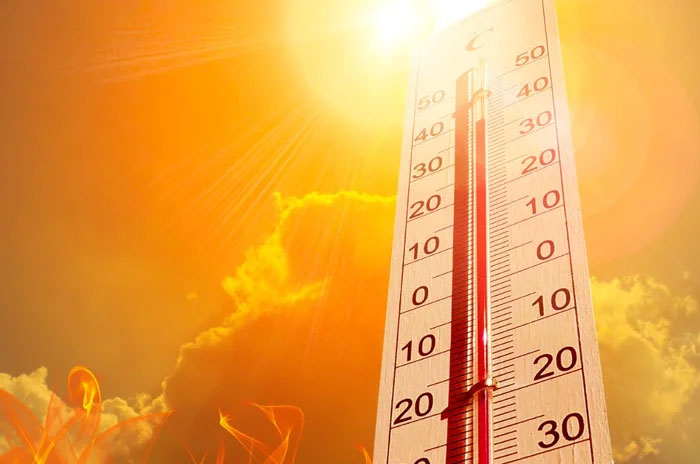
Shocking heat up to 104°F across Kazakhstan, Mongolia worse
“Kazhydromet issued storm warnings for June 16 in 16 regions and in the cities of Astana and Almaty, with severe thunderstorms and extreme heat expected across the country, Qazinform News Agency reports. To the east, Mongolia is reporting 114°F.
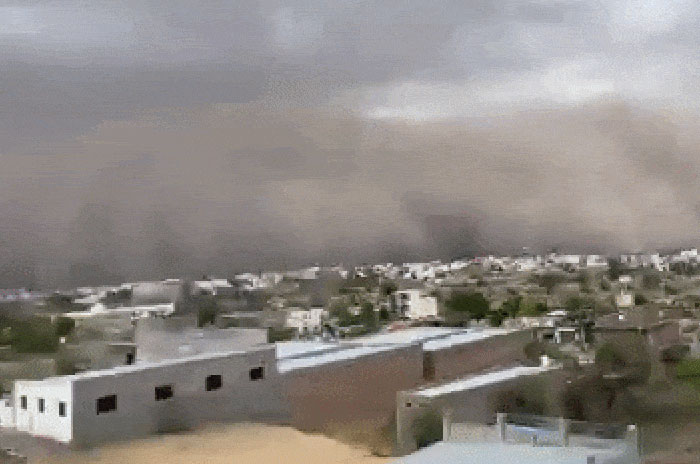
Massive Dust Storm Hits NW India with Zero Visibility
A massive dust storm swept across a highway in Rajasthan’s Churu district on Monday, reducing visibility to near zero and severely disrupting traffic movement as thick clouds of dust and strong winds engulfed the area.
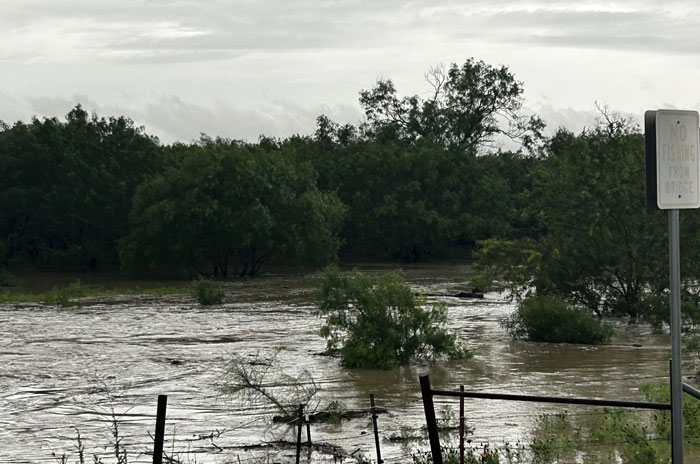
Flash floods hit Texas Hill Country, one dead
Record torrential rains triggered flash flood warnings across San Antonio, Waco and surrounding counties. San Antonio fire crews responded to nine high-water rescue calls as floodwaters created hazardous driving conditions across the city..
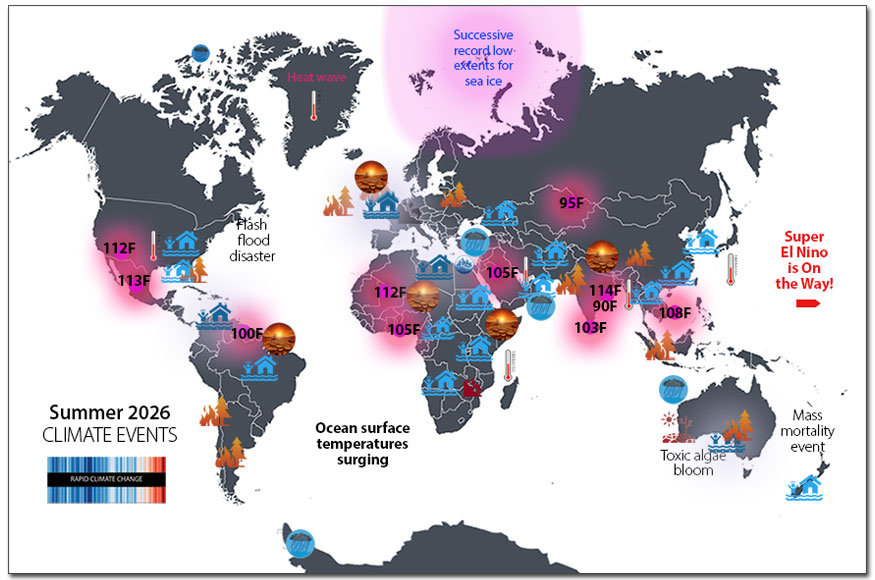
Drought | Flood | Heat
The European Centre for Medium-Range Weather Forecasts suggests this Super El Nino will be the strongest ever measured
New England is experiencing a serious heat wave already, with high temps topping 95°F in Boston even before summer is official. The intense heatwaves in Western Europe continue, especially in the UK. The global system that monitors of sea level rise in real time is being cut by the Trump administration: this is the three monkeys approach to denial. 2025 wildfires were the costliest ever globally. ANTARCTICA west coast missing an area of sea ice the size of France as crazy heat persists way down under. Driven by warming seas, red algae is invading the coast of Brittany.
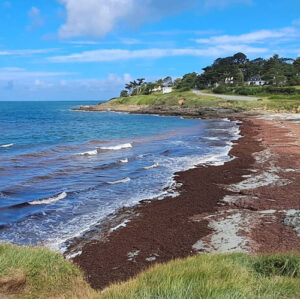
Driven by warming oceans, red algae on Brittany coast comes “way early.”
Large quantities of red algae have washed up on beaches in Brittany far earlier than usual this year, a phenomenon local officials say is linked to rising temperatures and warmer spring weather. While they traditionally take place around the height of summer – often as late as October – these “blooms” (as they are called) increasingly appear in May and June as spring temperatures rise sooner on the heating planet.
Like green algae, red algae present a health risk when large accumulations begin to decompose during periods of hot weather. Some harmful algal blooms produce toxins that cause stomach pain, skin irritation, headaches and respiratory problems. They also release Hydrogen Sulfide (H2S) gas, a poison and sometimes lethal gas. Jogger Death By Algae: The 2026 event occurs ten years after a jogger died on the Breton coast from inhaling the gas.
In addition to the warming waters that accelerate algae growth, pollution from large scale pig farms in Brittany contribute to the problem
Globally, algae and toxic seaweed incursions are fouling coastlines around the planet, including Florida, Australia, the Pacific Islands and the extended western coast of Europe. READ MORE
.
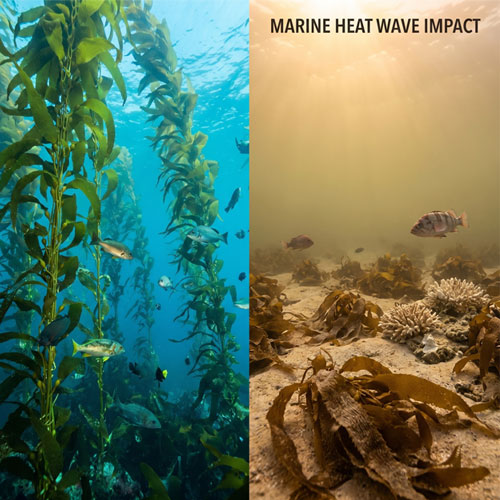
Climate impact on kelp forests seriously under estimated
Even if you aren’t exactly sure what a kelp forest is, the reality for these spectacular undersea ecosystems is dire. New research from the University of Victoria has found that the kelp forests around Vancouver Island were disappearing far earlier than scientists previously thought, highlighting that climate change has been altering these undersea ecosystems long before most people were aware anything was wrong.
SERIOUS CONSEQUENCES: Kelp forests are often called the “rainforests of the sea.” providing habitat for thousands of marine species, supporting fisheries, absorbing carbon, and reducing coastal erosion. Estimates suggest that 40–60% of kelp forests have been degraded or lost over the past 50 years, due to ocean warming and marine heatwaves, increasingly violent weather and pollution/ nutrient runoff.
Florida Orange juice is not just for breakfast anymore . . . or anything else
The Anita Bryant homophobic episodes of the 70’s is nothing compared to the existential crisis facing the collapsing Florida orange industry. The decline of Florida orange juice is one of the most dramatic agricultural crashes in modern history. Florida was once the world’s leading producer of orange juice, but production has fallen by roughly 90–95% since its peak in the late 1990s and early 2000s. The cause is a perfect storm of disease, violent weather and developers, with an underpinning of global warming exacerbating the catastrophe.

Weather chaos in Switzerland
A violent storm hit southern Ticino. Switzerland in early June as hailstones up to 3 inches in diameter damaged roofs, cars and fields. The storm set a new precipitation record for the southern slope of the Alps Within a few minutes, southern Ticino was transformed into a white landscape on Tuesday evening. A particularly heavy thunderstorm cell moved over the Mendrisiotto at around 9.30 pm, bringing torrential rain, strong gusts of wind and unusually large hailstones.
The Super El Niño: What to expect
El Niño has officially begun, and it is forecast to intensify into a very strong or “Super” El Niño with major shifts in global weather patterns and an even hotter climate, according to a new report released Thursday morning by the National Oceanic and Atmospheric Administration (NOAA).
New predictions from the European Centre for Medium-Range Weather Forecasts (ECMWF) indicate sea surface temperatures in the central equatorial Pacific Ocean will climb 5.47.2° F (3 C) above average by December 2026. The scariest predict a spike above 7.2° F (4 C).
El Niño is a periodic weather pattern in the tropical Pacific Ocean that alters winds and features unusually hot waters in the central and eastern Pacific. These changes in winds and ocean temperatures have knock-on effects on weather patterns worldwide.
NOAA’s Climate Prediction Center is giving this El Niño a 63% chance of becoming a “very strong” event (a Super El Niño) and one of the “largest El Niño events in the historical record. The Center is giving 100% odds of El Niño continuing through the fall and extremely high odds continuing into the winter.
WHAT WILL HAPPEN: Super El Niños transfer large amounts of heat from the ocean to the atmosphere, which is highly likely to mean another record setting year will follow in terms of global heat.
Effects to expect: Increase in heat waves | increased wildfire risk | greater stress on agriculture | extreme rainfall and flooding | increased drought especially in Australia, Indonesia, South Africa and rainforests | marine ecosystem disruption and extensive coral bleaching.
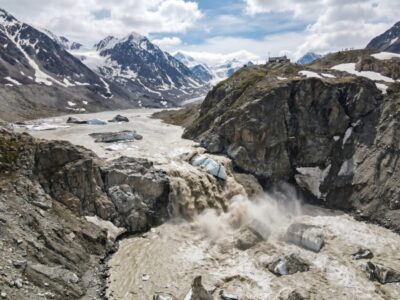
BC’s repeating Glacial Lake Outbursts reflect a growing global threat
For the third year in a row, evacuations have begun near the Place Glacier in Pemberton, British Colombia due to an imminent threat of a glacial lake outburst flood. Monitoring equipment shows that a lake near Place Glacier that saw outbursts in 2024 and 2025 is at risk of causing flooding again. The depth of the lake has reached the same level that it did when a previous outburst happened in 2025 — 80 ft. Scientists expect that the annual outbursts will occur until the glacier has completely receded.
GLOF events are increasing rapidly in Alpine regions around the world, threatening downstream villages and infrastructure. More on GLOF’s here.
Mumbai: When water crisis meets greed
Imagine a city of 20,000,000 that must depend on a massive fleet of private tankers trucks to supply water for the population. The tanker companies extract ground water from rapidly dwindling aquifers, often illegally. There are 500 water tanker owners and 2100 water tankers that operate in Mumbai.
Mumbai – the largest city in India – is facing a new escalation of its ongoing water supply crisis. While the Mumbai Water Tanker Association has backed off it’s strike after two days, the situation remains untenable in the extreme. The tanker companies were protesting the implementation of regulations that cut their legal rights to extract groundwater by about 10%. Those regulations were put in place because lakes and reservoirs are no longer able to meet demand. To make the situation worse, the amount of water extracted illegally from the rapidly dwindling aquifers is unknown.
The global water crisis is manifesting in more locations around the planet, with very little attention from national media. Current emergencies many decades in the making are the Ogallala Aquifer, the entire southwest, and a looming disaster in Corpus Christi (named for the body of our deceased lord and savior – fun stuff).
