Accelerating sea level rise: melting land ice also changes ocean chemistry

Accelerating land ice melt is also changing ocean chemistry

25% 

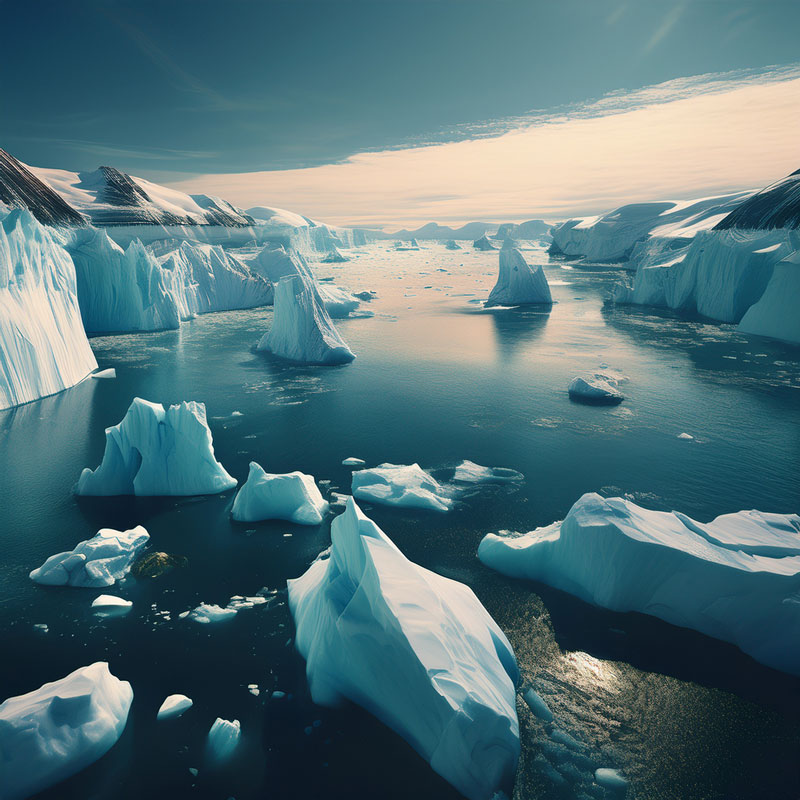
The massive Greenland ice cap is shrinking an by average of 30 million tons an hour – which is 20% more than was previously thought. This additional source of freshwater pouring into the North Atlantic contributes to the slowing of the Atlantic meridional overturning circulation (AMOC), a dire state of affairs for Europe’s climate. This alters salinity, which affects the system that powers the global water conveyor (explained below).

More on AMOC slowdown and other tipping points.

Ice loss from Antarctica continues to accelerate and is now estimated at 150 Gigatons per year. This is a sevenfold increase since the 80’s and adds an additional .5 mm per year to sea levels.  

Globally, mountain glaciers have been losing mass rapidly and contribute around 0.2 to 0.4 mm per year to sea-level rise.

SURPRISE!

Groundwater depletion is rapidly moving water to oceans, and under the radar source of sea level rise 

25% 

THE THIRD CAUSE IS UNKNOWN TO MOST PEOPLE.

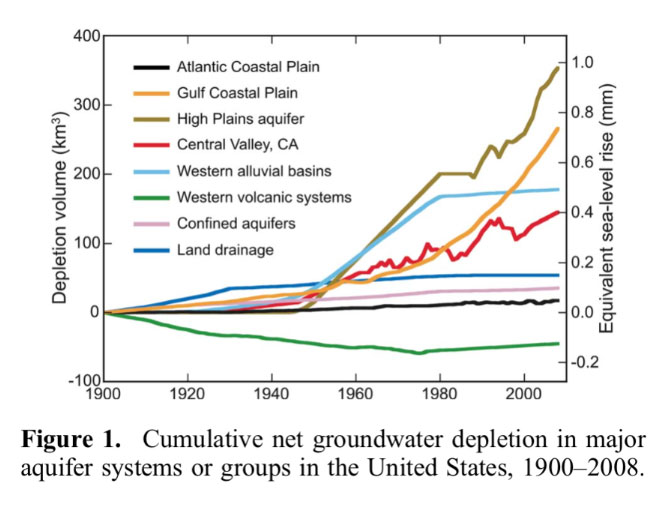
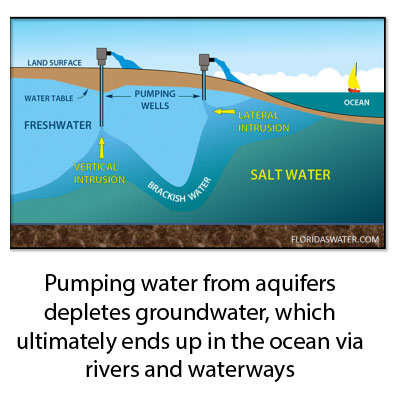
Groundwater depletion from irrigation and other human activities is a major though often overlooked, contributor to sea level rise, adding new freshwater to oceans that was previously stored on land. A relatively recent discover, this category of water transfer to the oceans may now equal or exceed melting glaciers and ice sheets. This human activity is causing a global shift in the water cycle, which is virtually never a good thing for humans.
More Here

Over pumping aquifers raises sea levels

Sea levels are rising due to thermal expansion

Thermal expansion of the ocean contributes more to sea level rise than melting polar ice

50%

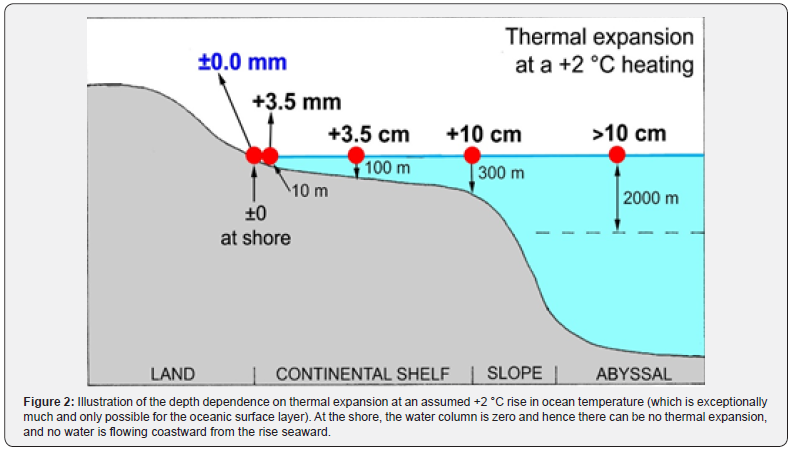
About half of current sea level rise is attributable to ocean thermal expansion. When seawater warms, it expands, and takes up more volume, significantly contributing to sea-level rise. as oceans absorb over 90% of Earth’s trapped heat from greenhouse gases, causing water molecules to spread out, leading to rising coastal waters. This process accounts for about half of global sea-level rise, with warmer temperatures increasing the total volume (not the amount of water, but rather the space the water takes up) of water in the planetary ocean, impacting coastal areas and ecosystems worldwide.
Gulf steam (AMOC) slowdown

Greenland and the slowing AMOC

GREENLAND AND THE AMOC

The Atlantic Meridional Overturning Circulation (AMOC) is weakening,  This slowdown, driven by Greenland ice melt and increased freshwater in the North Atlantic, threatens to cause severe weather shifts, including rapid European cooling, enhanced Atlantic sea-level rise, and intense drought.

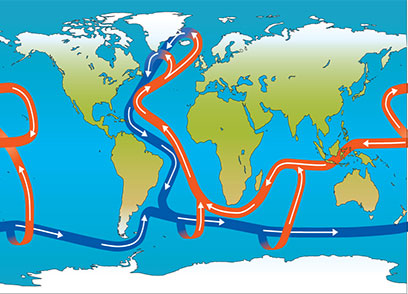
When examined independently, the accelerating melt rate of the Greenland Ice Sheets and the slowing of the AMOC are alarming in a fairly obvious way. There are trillions of tons of fresh water ice atop the Greenland land mass. As it continues to melt at ever increasing rates, it will add to ocean volume and sea level rise. The AMOC (Atlantic Meridional Overturning Circulation), which includes the Gulf Stream, carries warm tropical water to the North Atlantic, which moderates the temperatures of Northern Europe. The slowing of this ocean stream will fundamentally alter the climate of Europe. 

LESS HEAT MOVING NORTH TO WARM EUROPE

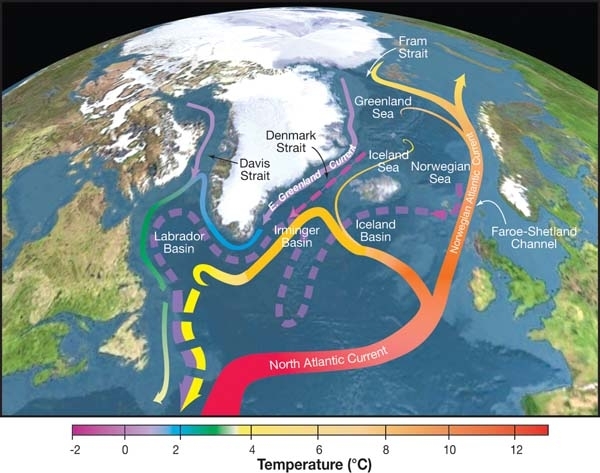
The relationship between these two systems is based on the fact that the AMOC is driven by water salinity. When the waters cool in the northern reaches, they sink to the bottom, which creates the overturning effect. That powers the current. When huge quantities of fresh water  are dumped into the salt water ocean, the salinity changes and the power of the overturning system is diminished.  

A weakened AMOC is also likely to compromise the northern Amazonia rain forest and bring warmer waters to Antarctica, hastening the coastal ice shelves collapse. 
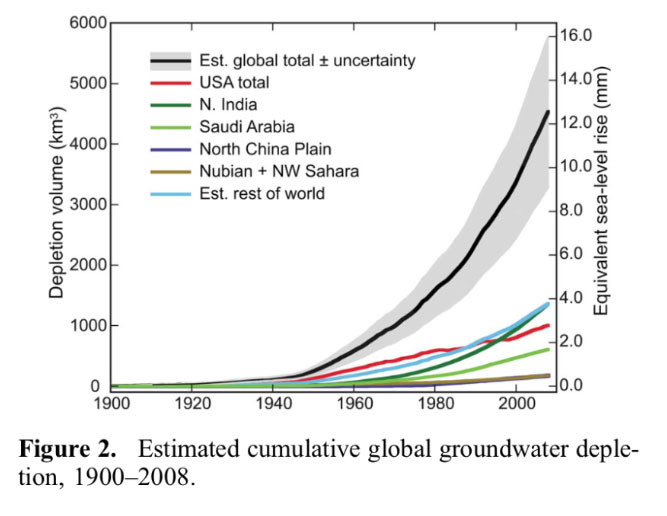
 

Sucking up groundwater and dumping it into the ocean

A new sea level rise factor augments melting ice caps and thermal ocean expansion

Those who have an interest in such matters understand that rapidly melting polar land ice and alpine glaciers is contributing to global see level rise. That is a fairly obvious causal chain. Temperatures increase, ice melts.  Less obvious is global thermal expansion of the oceans as a sea level driver. But the science makes sense: as the oceans continue to warm, the volume of water expands. There is no place else for the water to go than crawling up the continental coasts and swallowing up islands whole in the open ocean. 

The second worst thing that happens when you use up all the water:

When you guzzle up the water stored in Earth’s aquifers and don’t replace it, then you run out of water. As agriculture, mining, industry, data centers and bottled water grifters exploit underground water stores without replacing it, people run out of water to drink. Mostly poor people. The water crisis is now a worldwide emergency, with major cities such as Kabul and Mexico City on the brink.

The other thing that happens is that most of the water taken from underground drains into in the oceans via rivers and waterway, contributing a third source of sea level rise. Recent estimates come in at 1,100 cubic miles of groundwater removed from aquifers since 1900 have ended up in the oceans. 

In California, so much groundwater has been pumped from aquifers in parts of the San Joaquin Valley that the land is sinking, wreaking havoc with infrastructure roads..

The current rate of groundwater depletion around the world in increasing alarmingly. 

Groundwater depletion raises sea leve

Groundwater depletion causes sea level rise

Climate emergencies Summer 2025
Global Climate Emergencies Summer 2025

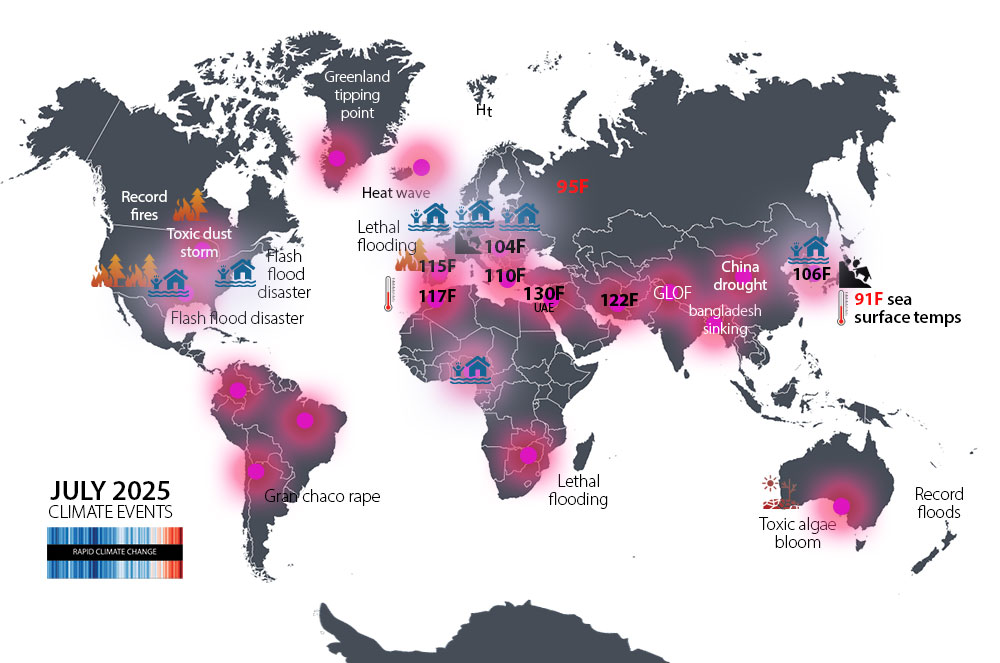
Catch up on the global map of current climate events Summer 2025

WATER IS AT THE CORE OF THE GLOBAL CLIMATE EMERGENCY

undefined

New fresh water from ice caps changes the salinity of the ocean / slows critical currents

As trillions of tons of land-ice melt and flow into the seas, it is not a mental stretch to understand that the only possible result is for sea levels to rise.* However, there is an equally concerning additional consequence: the slowing of the Atlantic Meridional Overturning Circulation (AMOC). 

The AMOC is driven by water salinity and density. When the waters cool in the northern reaches, they sink to the bottom which creates the overturning effect. When huge quantities of fresh water pour into the salt water ocean,  salinity decreases and the power of the conveyor system is diminished. Fresh water is less dense than saltier water.

There are trillions of tons of fresh water ice locked atop the Greenland land mass. When it enters the North Atlantic, it changes the density of the ocean, compromising the engine that drives the global current. Because the Gulf Stream carries warm tropical water to the North Atlantic, it is critical in moderating temperatures in Northern Europe. The slowing of this ocean stream will fundamentally alter the climate of Europe

*  although possibly a challenge for those who believe Noah’s little deluge covered the entire planet.

Ocean Thermal Expansion: In Theory and by a Simple Experiment


Thermal expansion: the hidden driver of sea level rise

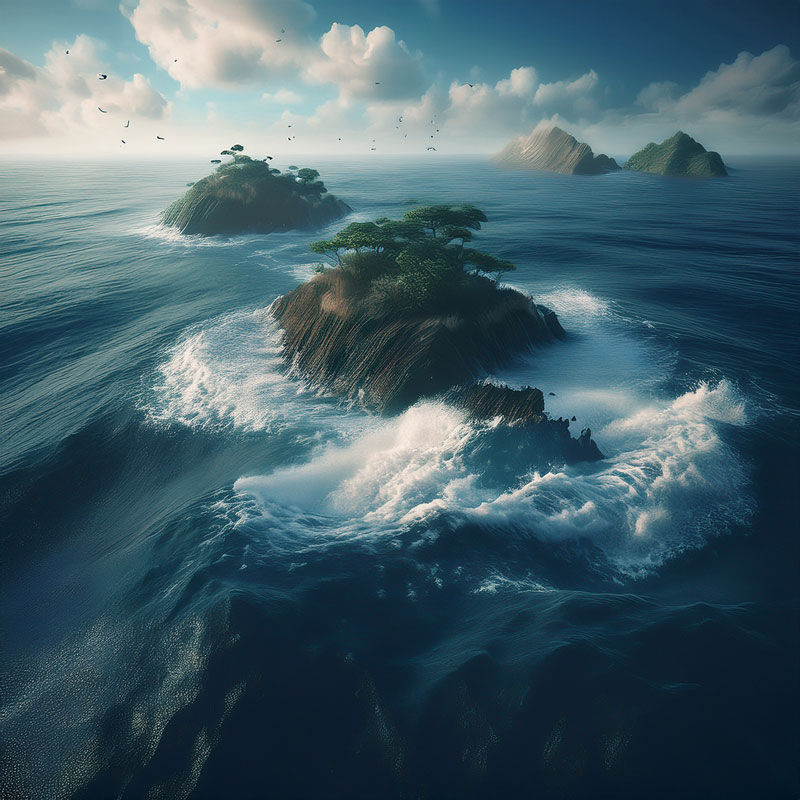
Thermal expansion is a law of physics that affects all substances. Increase the temperature of solid, liquid or gas and it will expand. This is easily observable with water, including about 350 quintillion gallons in the global ocean. Heat it up, the volume increases. Where is it going to go? About half of the measured global sea level rise on Earth is from warming waters and thermal expansion.

Coastal regions around the world are experiencing shockingly rapid inundation as salt water moves into river deltas and water supplies. Islands in the Pacific and elsewhere are experiencing a slow evacuation as the waters close over once dry land.

The danger of groundwater over-exploitation – Eco-intelligent™

The expected water crisis from Global exploitation of groundwater is here.

The planet’s supply of groundwater is being rapidly depleted much faster than it can be replenished. In general, industrial and commercial interests outrank the human need for drinking water. Kabul (7 million) is running out of water. Tehran (10 million+) is running out of water. Bulgarian cities are already rationing. Mexico City (25 million+) is at the breaking point. Johannesburg (6 million+) has been running dry for a decade.

Some of the most severely affected regions include:

  • India is world’s largest user of groundwater; many aquifers are in “critical” condition as commercial interests deplete aquifers.

  • China  the depletion the North China Plain aquifer threatens crop production

  • Middle East Low rainfall and overuse lead to severe stress in Saudi Arabia and Iran

  • U.S. Ogallala Aquifer, the largest reservoir of fresh water in the world is being depleted rapidly, threatening farming

  • Mexico, Pakistan, Egypt – Also facing long-term groundwater crises