“I’m out of superlatives…”*
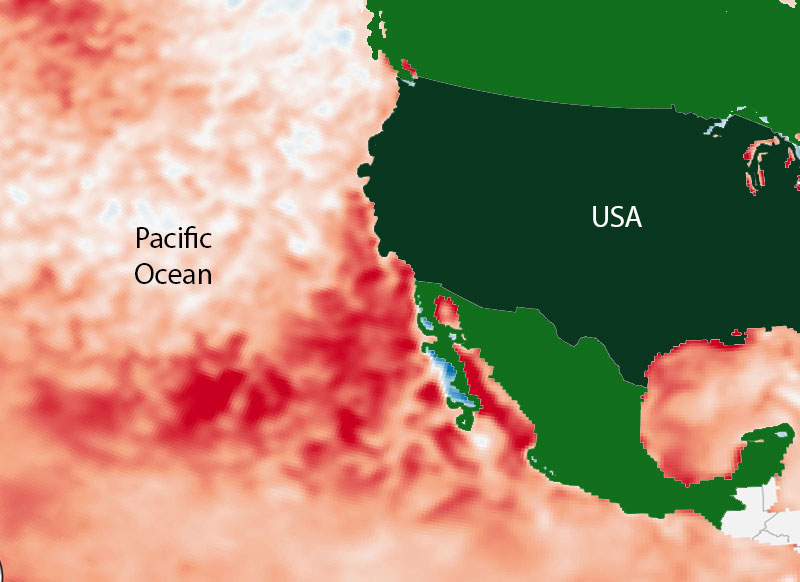
An enormous marine heatwave off the US west coast has got ocean and atmospheric scientists freaking out, although you’d never know it from the news coverage it isn’t receiving. The extreme temperature anomaly is affecting a vast expanse of the North Pacific in May 2026. The latest data shows intensifying ecological and environmental effects affecting marine life as well as weather patterns across North America.
Coastal waters along the U.S. West Coast have been roughly 3–4°F (≈1.5–2.5°C) above normal in places, while satellite analysis shows localized sea‑surface‑temperature anomalies exceeding +4°C in parts of the North Pacific on early‑May maps.
According to NOAA, the phenomenon is comprised of two distinct temperature events: a persistent coastal heatwave and a separate offshore warm pool. and are monitoring whether they will grow and merge later in summer or fall.
Forecasters are also concerned because a strong El Niño is likely to develop in 2026; if El Niño becomes established it would tend to reinforce and prolong Pacific warming. (NOAA/CPC ENSO outlooks in spring 2026 show elevated odds of El Niño by mid‑ to late‑2026.
The unusual area of warm water has persisted since peaking during September 2025 and still stretches thousands of miles from the California coastline – more than halfway across the Pacific – affecting a vast triangle-shaped region of oceanic habitats from Hawaii to British Columbia and southward to Mexico.
As recently as early April, marine scientists had hoped that the heatwave might diminish and the worst of its effects might be avoided. However, new projections released last week by the National Oceanic and Atmospheric Administration (NOAA) show it is now expected to expand and strengthen in the months to come.
Either of these climate conditions will create severe negative impacts across a wide swath of the planet. Together, the effects may well be catastrophic as the summer rolls on.
* University of Arizona atmospheric scientist Kin Wood

Accelerating global warming effects as systems combine
When a very strong (super) El Niño coincides with a marine heat wave, effects amplify and interact across the climate system and ecosystems. Key consequences:
Climate and weather
- Global temperatures spike: El Niño raises global mean surface temperature; a marine heat wave adds ocean heat storage—together push global and regional temperatures higher than either alone.
- Stronger, more extreme precipitation and flooding in El Niño-favored regions (e.g., western South America, parts of the southern U.S.): heavier storms, landslides, urban flooding.
- Worsened drought in regions that typically dry during El Niño (e.g., parts of Australia, Indonesia, India): agricultural stress, water shortages.
- Tropical cyclone behavior can change: some basins produce fewer storms, others produce more intense storms because of warmer sea surface temperatures and altered wind shear patterns.
- Increased heat waves on land and higher evaporation, raising wildfire risk in vulnerable regions.
.
Toll on Marine Life and Birds
Ecologists and bird‑rescue groups are already reporting seabird strandings and shifts in species ranges (e.g., subtropical species moving north). Marine‑heatwave conditions raise risks of harmful algal blooms, reduced productivity for fisheries (affecting salmon and other species), and broader ecosystem stress that can cascade for months or years.
Additional effects
- Severe coral bleaching and large-scale reef mortality due to prolonged high sea surface temperatures.
- Fishery collapse or massive shifts in species distributions as warm-water species move, upwelling weakens, and primary productivity drops.
- Hypoxia events and harmful algal blooms may increase, further stressing marine life.