Fungal diseases moving north as the West heats up and dries out
Valley Fever (Coccidioides) is one of dozens of diseases expanding range globally.
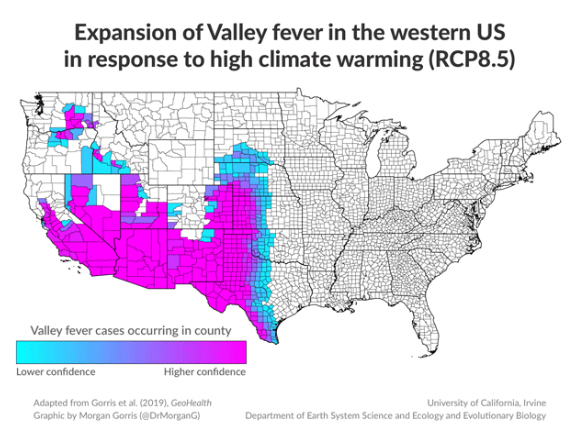
Climate change is the primary driver of the increasing risk of Valley Fever in the western United States. The effect is two fold, raising both the probability of infection in existing ranges and expanding the reach of the affliction northwards.
Historically, most U.S. Valley fever has occurred in Arizona and California, with cases also occurring in Nevada, New Mexico and parts of other western states. But as the historic drought progresses, Coccidioides spores have been documented considerably farther north, including Washington State. Climate modeling suggests that continued warming could make portions of states such as Idaho, Wyoming, Montana, Nebraska, North Dakota and South Dakota increasingly suitable for the fungus.
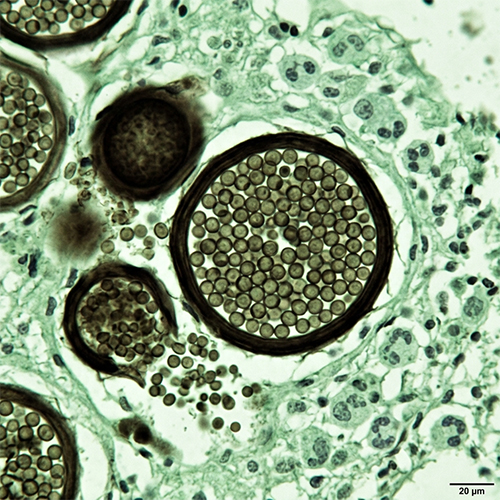
WHAT IS IT?
Coccidioides is an airborne soil fungus, found in the form of spores spread by the wind. Valley Fever is caused by inhaling the spores, which thrive in hot, relatively dry environments.
The primary way to contract Valley Fever is to inhale in the microscopic fungus which can be lifted into the air after infected soil is disturbed by things like high winds, construction, recreational activities and agriculture. The fungus gets deep in the lungs and mutates, which leads to a flu-like disease. Valley Fever doesn’t usually kill you, but it does make your wish you were dead. About 1% of cases are fatal, with 10% of patients developing long term lung damage.
Global warming is expanding the range of Valley Fever as the American West becomes more and more arid with the rise of global temperatures.
VALLEY FEVER GLOBAL WARMING DRIVERS
There are several mechanisms at work:
- Higher temperatures: Warmer conditions are associated with higher Valley fever incidence.
- Drought and drying soils: Dry soils become more prone to generating dust, which can carry fungal spores aloft.
- Rain | drought cycles: Rain can stimulate fungal growth, while subsequent drying can leave spores in the soil that become airborne. Research suggests substantial increases in risk follow swings from unusually wet conditions to drought.
- Longer dry seasons: Recent research using California data from 2000–2023 found that hot, dry conditions cause the Valley fever transmission season to begin earlier and end later. When both spring and fall were unusually dry, the estimated transmission season was nearly four weeks longer.
- Wildfires and dust: Fires disturb soil and vegetation, while drought and extreme heat increase dust. Both can increase airborne exposure to Coccidioides spores.
Valley Fever is spreading
Scientists are warming that the potential for an epidemic is significant. A 2026 CDC analysis found that Arizona’s reported Valley fever incidence approximately doubled between 2005 and 2022, with most cases concentrated in Maricopa, Pima and Pinal counties. About 95% of U.S. reported cases occur in Arizona and California. But that is likely to change.
California experienced a particularly striking episode in 2023, reporting 9,054 cases—its second-highest annual total on record. Researchers linked the subsequent high risk to the dramatic transition from drought to unusually heavy precipitation and back toward dry conditions.
Viruses and pathogens on the move world wide
The warming climate and land-use changes have been having a global effect on such well-known diseases like Dengue, Chikungunya and Yellow Fever. These are high profile maladies spread by mosquitoes, moving rapidly into new regions where there is not likely to be natural resistance. They are far from the only diseases coming your way.
A 2022 study estimates that more than half of known human pathogenic diseases could be aggravated by climate change.
As an example, take a look at Argentine Hemorrhagic Fever (AHF) a once rare but serious disease carried by rodents. Both the United States and Soviet Union researched them as a potential agent for biological weapons. That can’t be good. AHF was once confined mostly to rural areas, but is now moving into cities.

Dengue, a flulike illness that can be fatal, is one of the fastest-growing infectious diseases in parts of South America, their spread also linked to environmental degradation and a warming planet. More than 10 million cases and over 16,000 related deaths have been reported to the World Health Organization since the beginning of 2024..
Scientists have also linked climate change to the spread of the Andes virus, a rare but dangerous hantavirus — another type of rodent-borne pathogen present in South America — that was linked to three deaths on a cruise ship earlier this year.
ZOMBIE VIRUSES LURKING BENEATH THE (NOT SO) PERMAFROST?
One of the most powerful climate feedbacks is the release of methane once trapped beneath the frozen tundra or permafrost that covers much of the Arctic. But methane is not the only potentially scary thing under there. Permanently frozen environments are natural reservoirs for microorganisms, including viruses, bacteria and humans pathogens. It is not currently considered likely that dangerous microbes such as smallpox are about to be released, but there is no question that dormant viruses will be released as the Arctic continues to heat up. The region is warming twice as fast as the rest of the planet. Which is warming very fast.
In 2015, researchers from Aix-Marseille University isolated two large DNA viruses in Siberia frozen for 30,000 years in ancient permafrost. They were not a threat to humans.
There was a well-documented anthrax outbreak in 2016 in Siberia. It killed thousands of reindeer. The cause of the outbreak is attributed to the activation of spores due to a permafrost thaw, accelerated during the summer heat wave of that year.