Glacial Lake Outbursts | Collapsing Permafrost | Feedback loops
Crumbling mountains | Atlantic Meridional Overturning Current
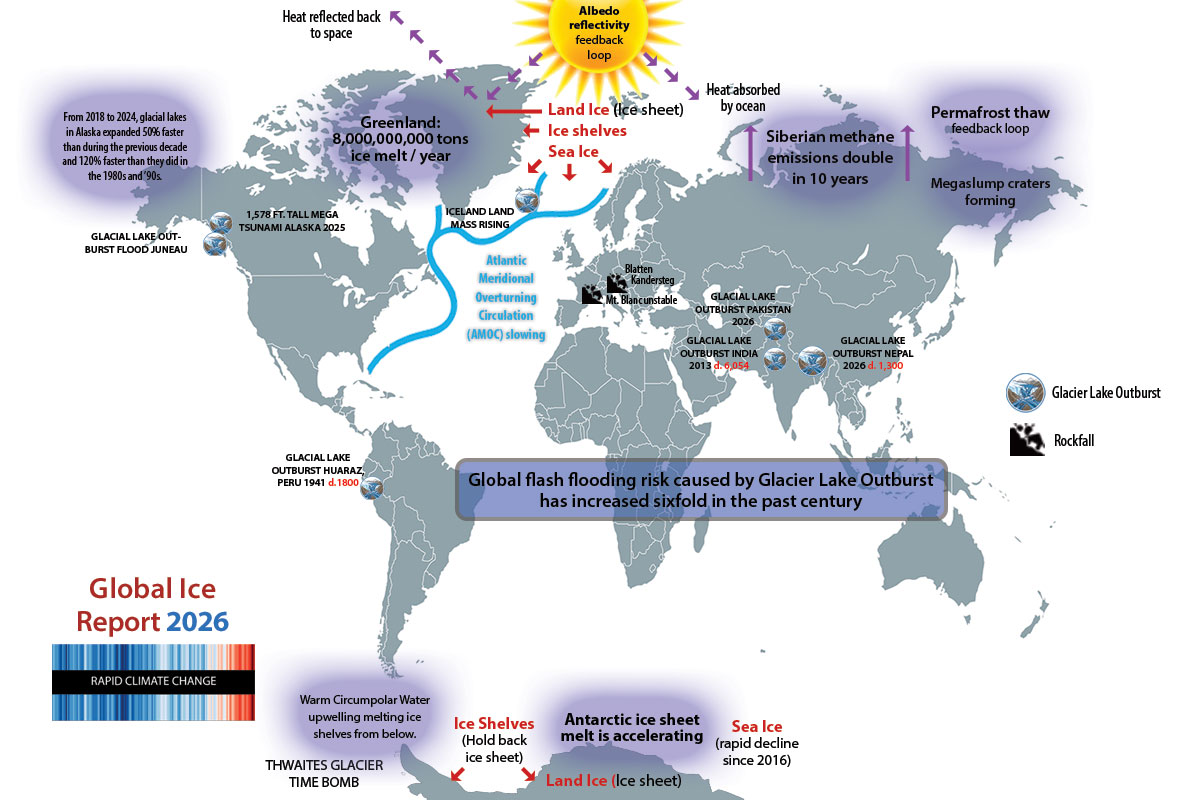
The key role of ice in global warming
The cause and effect relationship between runaway global warming and Earth’s vast stores of frozen water is far more significant than melting ice caps and shrinking polar bear habitat. From Greenland’s ice sheets to Siberian permafrost thaw to collapsing Alpine mountain slopes, there is virtually nowhere on the Earth the planet’s vast reserves of ice aren’t melting fast. For better or worse, the consequences of this phenomenon are not obvious on a global scale. This page covers several interrelated topics that don’t penetrate public awareness.
- Albedo reflectivity feedback
- Permafrost collapse \ methane feedback
- Glacier Lake Outburst Floods
- Alpine mountain slope collapse triggered by melting ice “glue”
- The Third Pole and the threat to Asian fresh water supply
- The affect of fresh water melt on the Atlantic Meridional Overturning Circulation (AMOC)
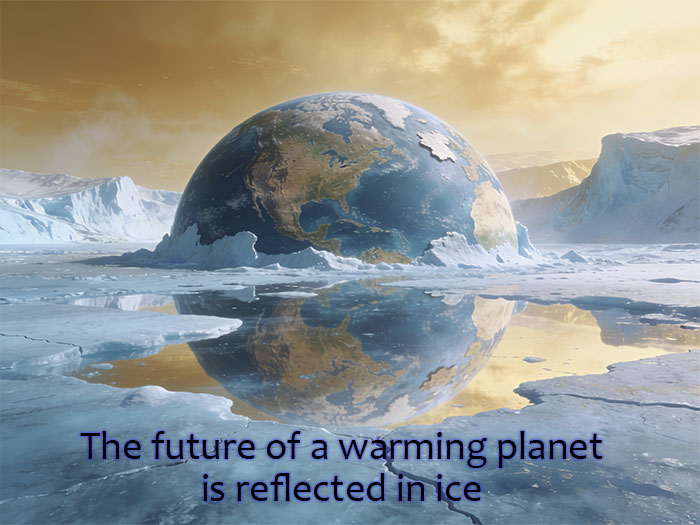
Polar Ice Formations: How they affect global climate
Fundamentals: Location, location, location
A key factor in global ice melting patterns is an often overlooked matter of basic geography.
- The North Pole is frozen ocean (Sea Ice)
- The South Pole is a massive land continent covered by trillions of tons of snow pack and ice (land ice, sea ice, shelf ice).
For the purposes of climate science, the three categories of ice are dictated by where ice is located and what state of matter it is in.
SEA ICE : Disappearing rapidly in the Arctic and more sporadically in the Antarctic since 2016. Sea ice floats but does not raise sea levels significantly when it melts. It does affect weather patterns and the Albedo reflectivity feedback. Extreme Antarctic sea ice variations have contributed to ocean current destabilization, which in turn destablizes weather patterns.
LAND ICE (fresh water): Trillions of tons of land ice on Greenland, Alaska, Iceland and the Antarctic continent contain enough fresh water to raise sea levels several meters..
SHELF ICE (fresh water): Hybrid formations are critical to braking the flow of land ice into the ocean. The “front” of an ice shelf rests on land and the “back” floats in the ocean, subjecting it to accelerated warming. (See middle column)
The Doomsday Ice Shelf
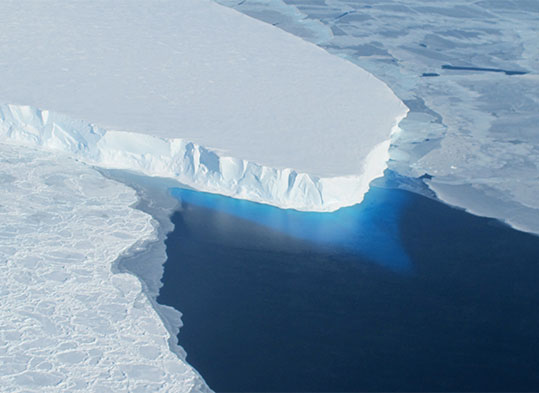
The Twaites Glacier ice shelf on the West Antarctic peninsula is known as the “Doomsday Glacier.” It is expected to break up in the very near future. If it collapsed completely, it would raise global sea levels about two feet. Equally alarming, the Thwaites and other coastal shelves act as a brake on the advancing land ice on the continent behind them.
Albedo Reflectivity Feedback
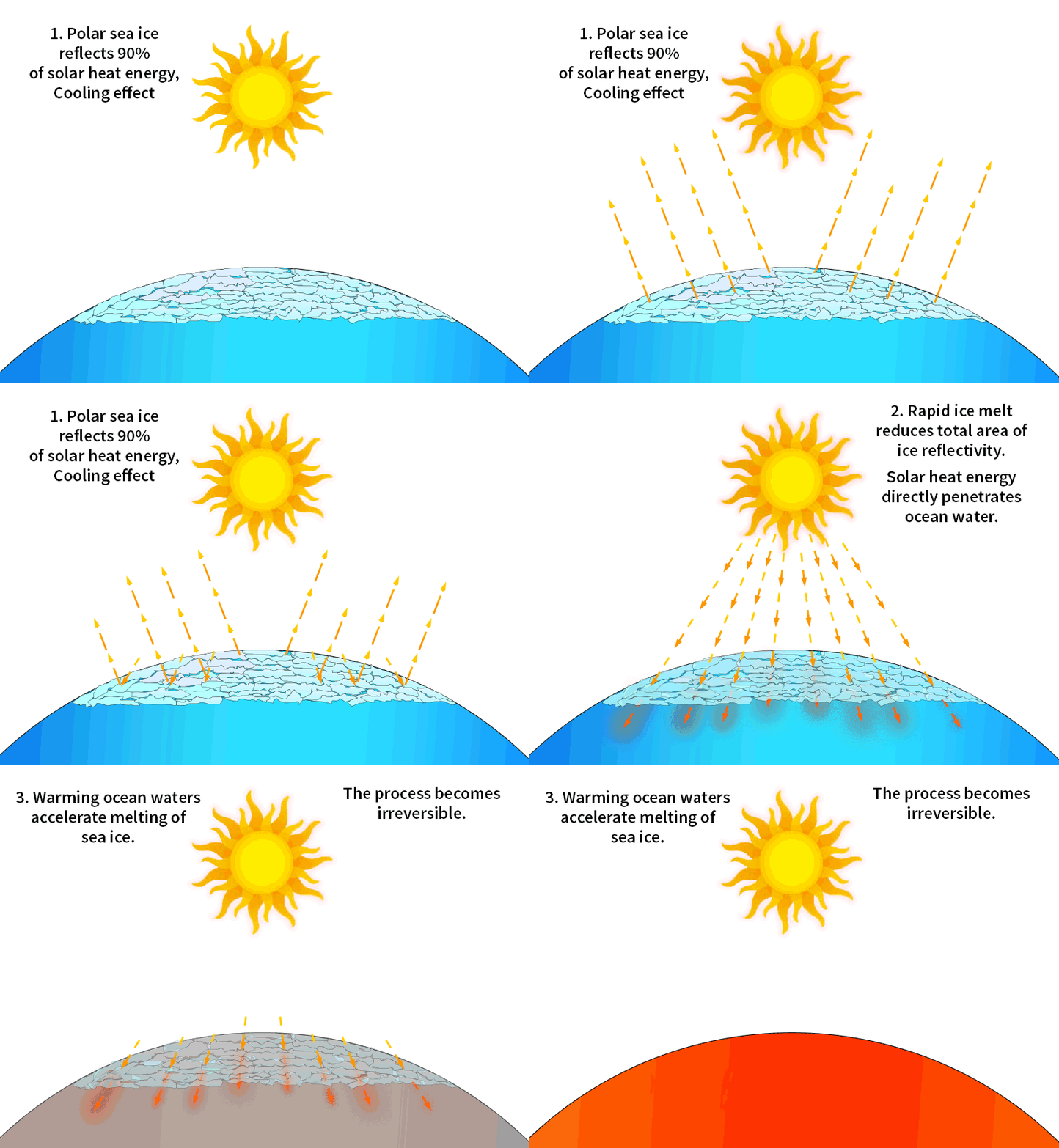
ALBEDO REFLECTIVITY FEEDBACK LOOP: The mechanism of this relentless positive feedback cycle is easy to understand. When sunlight radiates on Ice and snow, the heat energy is reflected back into space. But when sea ice disappears, the heat energy is absorbed directly into dark ocean water, heating it. The warm ocean melts more ice, which then opens more water to the heat energy. Repeat. See other climate feedbacks..
“Third pole” ice melt threatens water supplies for 2 billion humans
The Hindu Kush Himalaya region supplies water to major river systems including the Indus, Ganges, Brahmaputra, Yangtze, Yellow River, Mekong and Amu Darya
The Himalayan ecosphere is changing before our eyes
DISAPPEARING ICE IN HIMALAYAN GLACIERS IS ACCELERATING A MAMMOTH WATER CRISIS
The Himalayas store more frozen water than any other source except the Arctic and Antarctic ice sheets. While glaciers are visually compelling as tourist attractions, they are also essential as renewable water sources for agriculture and drinking water. These high mountain glaciers feed rivers that sustain nearly one-fourth of the world’s population. For thousands of years, billions of humans downstream have relied on a predictable seasonal release of glacial water into rivers, but global warming has quickly changed the scenario. With some glaciers losing ice mass at four times the normal rate, the region faces a convergence of environmental, health, and geopolitical crises.
TWO-EDGED SWORD: Near term, accelerated melting produces too much water too quickly—including devastating Glacial Lake Outburst Floods (GLOFs – see right column). Longer term, continued glacier shrinkage means less dependable water during the dry season, when millions of people most need it. At some point, when the glaciers are gone, the outcome is the permanent end of this water source.
.
Glacial Lake Outburst Floods
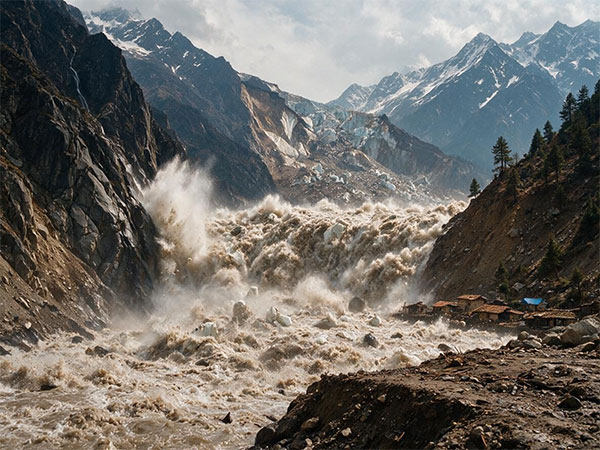
While the catastrophic Nepal event that killed 15,00 in
August 2026 is a major GLOF event, it is far from an isolated occurrence. In 2023, the South Lhonak GLOF in Sikkim, India, killed dozens of people and caused extensive infrastructure damage.
HOW GLOFs HAPPEN: As glaciers retreat, meltwater accumulates in lakes behind unstable moraine or ice dams. These lakes can grow rapidly. A landslide, avalanche, ice collapse, earthquake or extreme rainfall can suddenly displace water or breach the dam:
These floods travel rapidly down narrow valleys, carrying boulders, mud, trees and enormous quantities of sediment.
About 200 glacial lakes across the Hindu Kush Himalaya are considered dangerous. A significant acceleration in GLOF events began in the 1980s, with the annual frequency increasing from 5.2 GLOFs during 1981–1990 to 15.2 GLOFs during 2011–2020. Overall, the long-term trajectory of reported GLOF frequency parallels variations in global air temperature, with a lag of about 20 years. GLOF risk will increase substantially as warming continues
Destabilized mountain structure
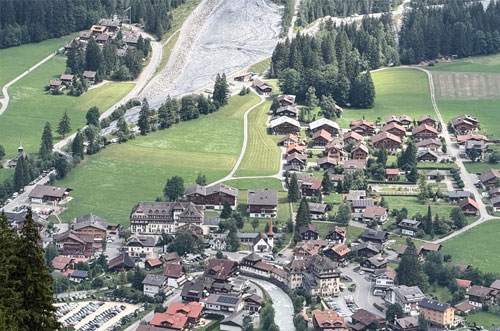
DESTABILIZATION: ROCK FALLS The Himalayan climate threat is more complex than melting glaciers alone. In a separate process. thawing alpine permafrost is causing a destabilization of the entire high-mountain environment.
For thousands of years, rock formations have been held together by ice to create a permafrost, which functions more or less as a “glue” to hold rock and soil in place. When ice that has previously remained frozen year round begins to melt and refreeze, water penetrates cracks previously stablized by frozen soil. As this cycle repeats, the entire mountain slope is structurally compromised. At some point, the side of the mountain fails, in the form of a rock fall or landslide. Rockslides often trigger GLOFs as debris cascades into glacial valleys.
Glacier retreat also removes the ice that can buttress mountain slopes.
“At some point, when the glaciers are gone, the outcome is the permanent end of this water source.”
Global consequences of rapid Permafrost thaw
A relentless methane feedback loop and transformed terrain
Driven by Arctic warming four times faster than the rest of the planet, the vast tundra plains of the north are thawing rapidly. While relatively few people think much about these unseen forces, the ramifications are global and implacable.
Methane Plumes: Melting permafrost is causing release of CO2 and CH4 trapped beneath once frozen surface. This is one cause for the rapid uptick in global atmospheric methane. Siberian levels of CH4 emissions have doubled in ten years.
Infrastructure Collapse: Biblical savior Joshua ben Joseph recommended not building your house on sand, but he should have also cautioned us not to build on permafrost. In Alaska, Siberia and northern Canada, buildings, highways and pipelines are falling down and smashing into the sea. Humans constructed these artifacts under the assumption that the land would stay solid, but it is NOT staying solid. As the ground sinks, humanity’s limitations are exposed. The situation is worse in coastal communities as increased water temperatures reduce protective ice and allow waves to wreck permafrost bluffs and increase erosion.
Read a current story on collapsing buildings in Alaska..
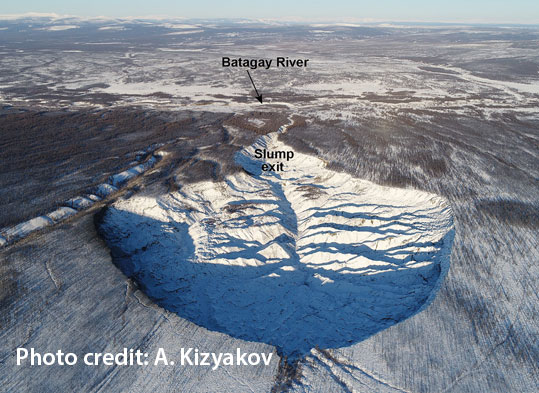
Megaslump Craters: These massive blowholes are blasting out all over the far north, transforming Arctic terrain into a spooky landscape called Thermokarst. These unsettling and often very large craters (also known as thaw slumps) are formed as once-trapped methane escapes the permafrost that once trapped it below. Megaslumps and the starkly strange thermokarst terrrain that accompanies them are not new, but they are multiplying as the tundra transforms. Sometimes a megaslump starts with a small soil collapse, other times there is a dramatic blowout when pressure grows too great. Arctic scientists now videotape footage of grassland wobbling as the substrata becomes less solid. Multiple researchers have entertained themselves by setting escaping methane gas afire as it is released from long-frozen ponds..
Microbes beneath the tundra: Pathogens have already been released:
Permanently frozen environments are natural reservoirs for microorganisms, including viruses, bacteria and humans pathogens. It is not currently considered likely that dangerous microbes such as smallpox are about to be released, but there is no question that dormant viruses will be released as the Arctic continues to heat up. The region is warming four times as fast as the rest of the planet. Which is warming very fast.
In 2015, researchers from Aix-Marseille University isolated two large DNA viruses in Siberia frozen for 30,000 years in ancient permafrost. They were not a threat to humans.
There was a well-documented anthrax outbreak in 2016 in Siberia. It killed thousands of reindeer. The cause of the outbreak is attributed to the activation of spores due to a permafrost thaw, accelerated during the summer heat wave of that year.
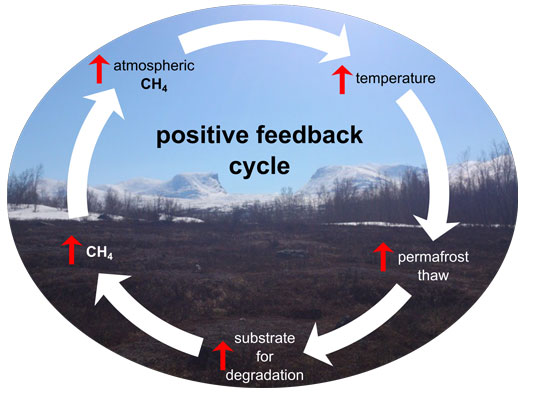
Powerful Methane Feedback Loop as Arctic tundra thaws
- Permafrost thaws, releasing greenhouse gases (CO2 , CH4).
- GHG’s trap heat in the atmosphere, increasing surface temperatures
- Permafrost melts faster, releasing more CH4.
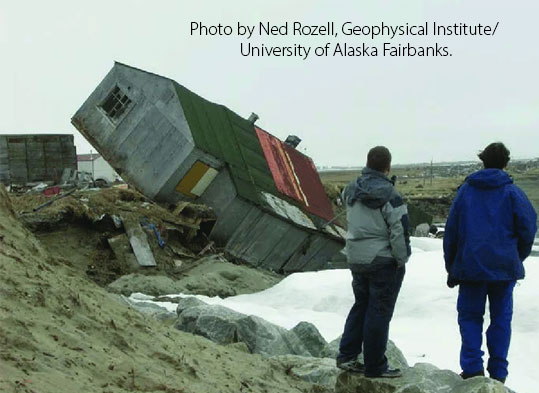
Collapsing Arctic infrastructure as permafrost destabilizes: Nature has a way of pointing out the hubris of human endeavor.
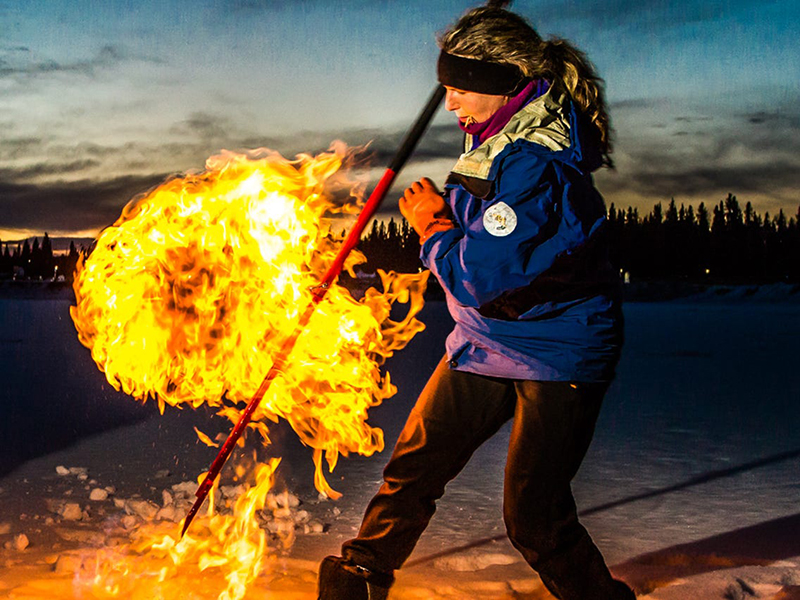
As once frozen Arctic ponds melt, flammable methane lurks beneath the surface.
“While relatively few people think much about these unseen forces, the ramifications are global and implacable..”
Greenland and Iceland: Unexpected forces at work
Rising land masses and changing global ocean currents
As massive quantities of fresh water enter the North Atlantic, things are changing quickly
1. THE ADDITION OF MASSIVE AMOUNTS OF FRESH WATER INTO THE NORTH ATLANTIC IS SLOWING DOWN THE GULF STREAM (AMOC)
The Gulf Stream is the best known component of the global ocean current known as the Atlantic Meridional Overturning Circulation (AMOC). This global current is responsible for a major determining factor for planetary weather. It moderates Northern Europe’s climate, preventing a climate more like Siberia’s (see middle column for more).
2. THE LAND MASS OF BOTH ISLANDS IS RISING AS THEY SHED THE WEIGHT OF ICE CAPS
There is no question that the addition of two mile thick melting ice caps into the ocean is raising sea levels. There is a range of projections regarding how quickly this process is taking place, but there is no doubt that it is gaining speed. Sea level rise is about double what it was in 1993.
But there is a less obvious effect as well. As the ice sheets melt and flow into the North Atlantic, the land beneath is lifting up. This paradoxical scenario, in that these two land masses will experience less net sea level rise that other coastal areas.
.
Slowing the Atlantic Current
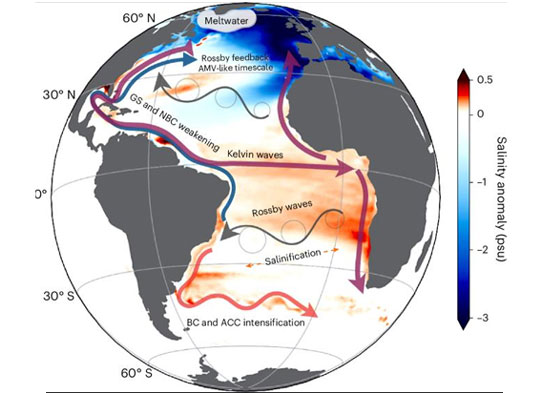
Melting of the Greenland Ice Sheet weakens the Atlantic Meridional Overturning Circulation (AMOC) by shedding colossal quantities of fresh water to the North Atlantic. The system is currently the weakest it’s been in more than 1,000 years, having lost 10% to 20% of its strength due to climate change.
The AMOC is essentially a huge ocean conveyor that distributes heat from Tropical regions to the north. When the current slows, it transports less heat to Northern Europe. Even as the specific magnitude of the changes are the topic of ongoing research, the basics of the mechanism are straightforward and measurable. Most research indicates that the AMOC is already slowing.
HOW IT WORKS: Warm, salty surface water moves northward through the Atlantic. In the subpolar North Atlantic and Nordic Seas, some of this water cools, becomes denser and sinks. The cooler water then flows back southward. This sinking action is the primary engine driving the overturning circulation.
Freshwater stored on land. When Greenland’s ice sheet melts and water reaches the North Atlantic, it changes the salinity of the ocean. The Greenland ice sheet contains enough freshwater to raise global sea levels by about 25 feet (7.4 meters) if it were to melt completely. It is the second-largest body of ice on Earth, and it is currently losing mass at an accelerating rate due to surface melting and the calving of glaciers into the sea. Credible estimates of melt rate are 12 million gallons a second or 266 billion tons a year. See article on sea level rise.
Arctic islands land mass lifting
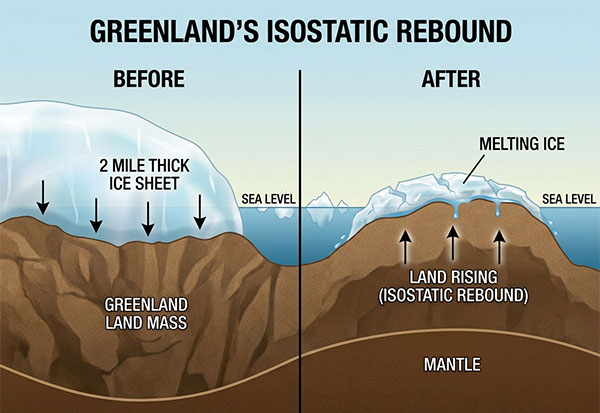
As the miles-thick ice caps that cover Greenland and Iceland melt and pour into the ocean, the land beneath is rebounding as the burden eases. The seas around them may actually appear to be lower when compared to the global inundations that are happening around the rest of the planet. Even as these two islands are contribute significantly to global sea level rise – about 20% – this paradox will mean expanding coastlines, dried-up fjords, and unforeseen challenges.